

A savings challenge turns “I should save more” into a simple game with a finish line. You follow a set pattern, tick off a tracker, and by the end of the year you have a real sum in the bank, anywhere from a few hundred to several thousand dollars depending on the challenge you pick.
This savings challenge 2027 guide covers eight challenges, with the exact totals, what each costs per month, a few calendar quirks that make 2027 a good year to start, and tips to actually finish.
In this guide
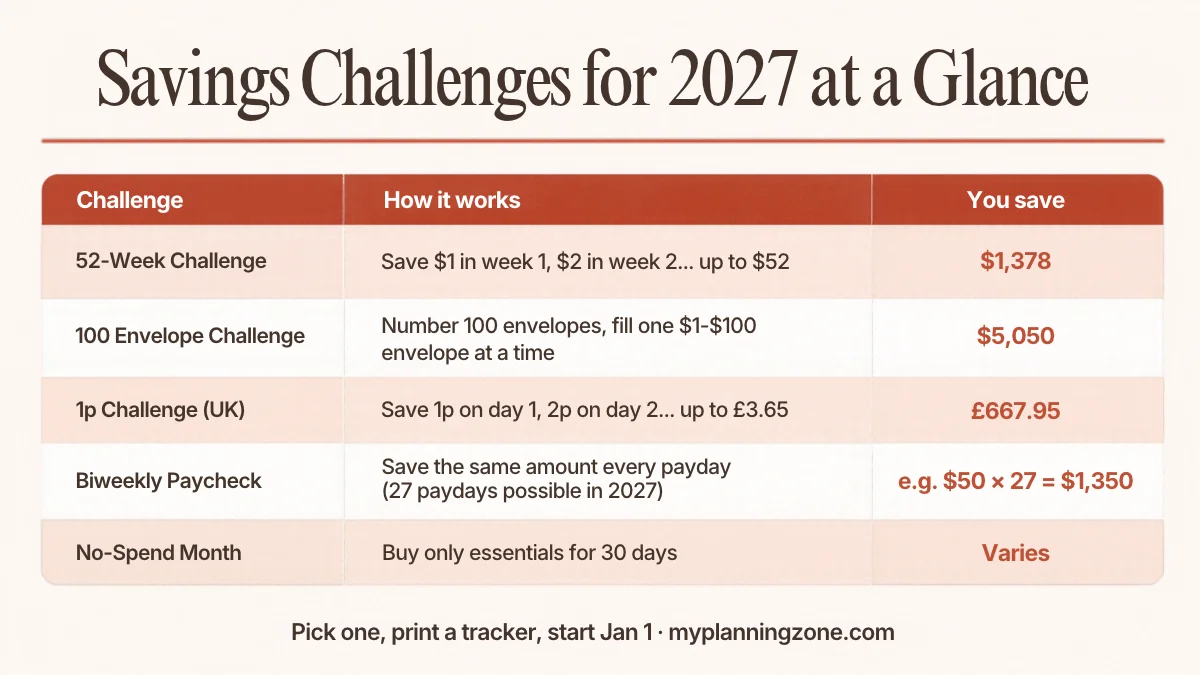
Savings Challenge 2027: The Options at a Glance
| Challenge | How it works | Total saved | Best for |
|---|---|---|---|
| 52-week challenge | Save $1 in week 1, $2 in week 2… $52 in week 52 | $1,378 | Beginners |
| 100 envelope challenge | Fill 100 numbered envelopes with $1 to $100 | $5,050 | Bigger goals |
| 1p challenge (UK) | Save 1p on day 1, 2p on day 2… £3.65 on day 365 | £667.95 | Daily habit builders |
| Biweekly paycheck challenge | Save a fixed amount every payday | e.g. $50 × 26 = $1,300 | Steady budgets |
| $5 bill challenge | Save every $5 bill you receive | Varies | Cash users |
| No-spend month | Buy only essentials for 30 days | Varies | Resetting habits |
| Round-up challenge | Round purchases up to the next dollar and save the difference | Varies | Hands-off savers |
| $1,000 in 30 days | Hit a set daily target for a month | $1,000 | Quick, short goals |
Why 2027 Is a Good Year to Start
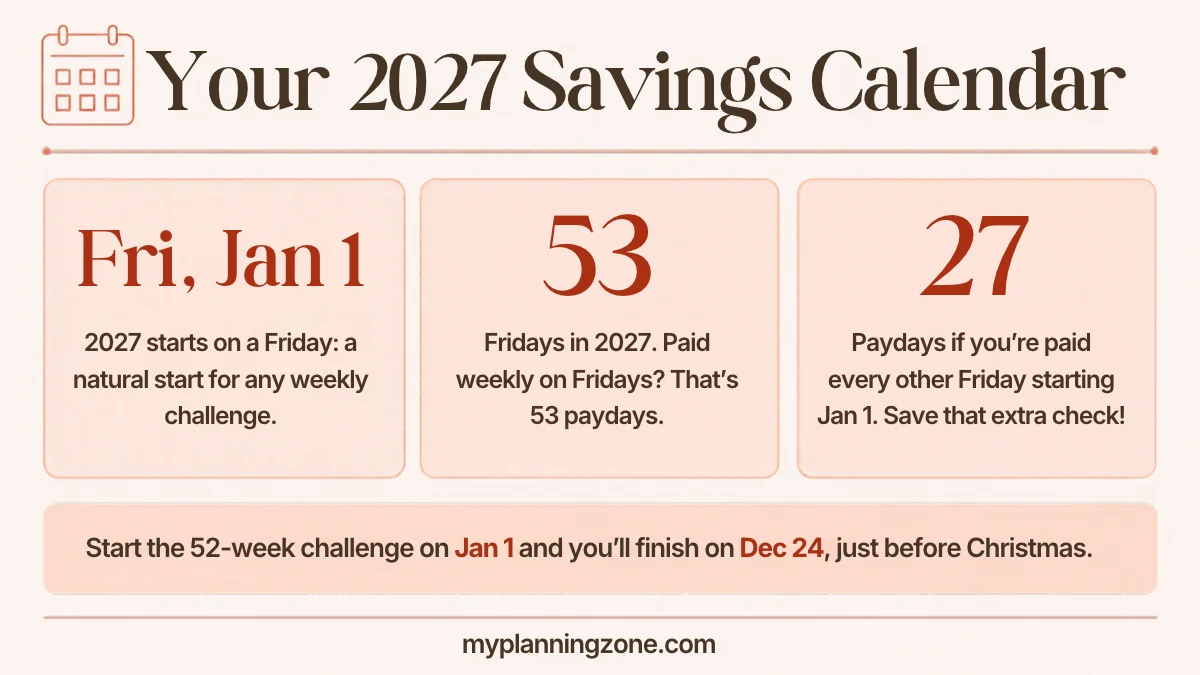
- January 1, 2027 is a Friday. Many people get paid on Fridays, so your first deposit can land on day one.
- 2027 has 53 Fridays. If you’re paid weekly on Fridays, you’ll get 53 paychecks this year instead of the usual 52.
- Paid every other Friday starting January 1? That works out to 27 paydays in 2027, one more than usual. Saving that whole extra check is an easy win.
- Start the 52-week challenge on January 1 and your last deposit falls on December 24, just in time for Christmas.
Your exact number of paydays depends on your employer’s schedule, so check your first 2027 pay date before you plan around an extra check.
8 Savings Challenges for 2027
1. The 52-Week Money Challenge ($1,378)
The classic. Save $1 in the first week, $2 in the second, and keep going up by $1 a week until you save $52 in week 52. Add it up and you’ll have $1,378. That works out to about $115 a month on average, but it starts small and gets harder in the fall, right when holiday spending kicks in.
Tip: try the reverse 52-week challenge. Start with $52 in January, when motivation is high, and finish with $1 in December. Same total, much easier holidays.
2. The 100 Envelope Challenge ($5,050)
Number 100 envelopes from 1 to 100. Each time you save, pick an envelope at random and put in that many dollars. When all 100 are full, you’ll have $5,050.
Doing one envelope a day finishes in 100 days but averages about $50 a day, which is a lot for most budgets. Spreading it across the year is more realistic: two envelopes a week finishes in 50 weeks, averaging about $101 a week or roughly $420 a month. Pull the big numbers on paydays and the small ones in tight weeks.
3. The 1p Saving Challenge (£667.95)
Popular in the UK: save 1p on day 1, 2p on day 2, and keep adding a penny a day until you save £3.65 on day 365. The total is £667.95. Because the daily amounts are tiny at first, it’s a gentle way to build a habit. As with the 52-week challenge, doing it in reverse makes December easier.
4. The Biweekly Paycheck Challenge
Pick an amount you can save every payday and never skip it. $50 a paycheck over 26 paydays is $1,300; $100 is $2,600. If you’re one of the people with 27 paydays in 2027, add the extra check on top. It’s the least exciting challenge on this list, and often the most successful, because it’s built around money you already know is coming.
Not sure how much you can spare? Our guide on how to plan your paycheck helps you find the number.
5. The $5 Bill Challenge
Every time a $5 bill lands in your wallet, it goes into a jar instead of back out. The total depends on how often you use cash, but it’s a painless way to save if you still pay in cash for coffee, parking or groceries.
6. The No-Spend Month
For 30 days, spend money only on essentials: rent, bills, groceries, fuel and anything already scheduled. No takeout, no impulse buys, no “just browsing”. Write down the money you would normally have spent and move it to savings at the end of the month. January, right after the holidays, is a popular time to try it.
7. The Round-Up Challenge
Every time you buy something, round the price up to the next dollar and save the difference. A $4.30 coffee means 70 cents saved. Many banks and apps can do this automatically, which makes it the most hands-off challenge here.
8. $1,000 in 30 Days
A short, intense challenge: about $33 a day for a month, usually through a mix of cutting spending, selling things you no longer use and picking up extra income. It’s great for a specific goal, like a deposit or an emergency fund starter.
Which Challenge Should You Choose?
| If you can save about… | Try | Year-end total |
|---|---|---|
| $1 to $3 a day | 1p challenge (UK) or round-ups | Around £668 or more |
| $100 to $120 a month | 52-week challenge | $1,378 |
| $50 to $100 a paycheck | Biweekly paycheck challenge | $1,300 to $2,700 |
| About $420 a month | 100 envelope challenge | $5,050 |
Be honest about your budget. A smaller challenge you finish beats a big one you abandon in March. You can always stack a second challenge on top later in the year.
How to Actually Finish Your Savings Challenge
- Pay yourself first. Move the money on payday, before you spend anything else. Setting up an automatic transfer from checking to savings means you don’t have to remember.
- Keep it separate. Use a dedicated savings account so the money isn’t sitting next to your spending money. In the US, deposits at FDIC-insured banks are protected up to $250,000 per depositor, per bank, for each account ownership category. Cash in envelopes is motivating, but it’s easier to lose or “borrow”.
- Track it where you’ll see it. Coloring in a box on a printed tracker each week is surprisingly motivating.
- Plan a catch-up week. If you miss a deposit, don’t quit. Double up next week or move that amount to a month with a bonus or tax refund.
- Give the money a job. “Christmas 2027”, “emergency fund” or “summer trip” is far more motivating than “savings”.

Want trackers ready to print? Our Printable Money Saving Challenge pack includes dozens of challenge trackers, from $100 in 30 days to $10,000 in 52 weeks, so you can pick the one that fits your budget and color it in as you go.
Keep reading: New Year Goals for 2027: How to Set Goals You’ll Actually Keep
Savings Challenge FAQs
How much will I save with the 52-week money challenge?
$1,378. You save $1 in week 1, $2 in week 2 and so on up to $52 in week 52, which adds up to $1,378, or about $115 a month on average.
How much money is in the 100 envelope challenge?
$5,050. The envelopes are numbered 1 to 100, and filling every envelope with its number in dollars adds up to $5,050.
What is the best savings challenge for beginners?
The 52-week challenge or a fixed biweekly paycheck challenge. Both start with manageable amounts, and the paycheck version is easy to automate.
When should I start a savings challenge?
Any time works, but January 1 is a natural start. In 2027, January 1 falls on a Friday, so weekly challenges line up neatly with Friday paydays and a 52-week challenge finishes on December 24.
What is the 1p saving challenge?
A UK challenge where you save 1p on day 1, 2p on day 2 and so on, adding a penny each day until you save £3.65 on day 365. The total for the year is £667.95.
Final Thoughts
The best savings challenge for 2027 is the one you’ll stick with. Pick one that fits your budget, print a tracker, set up an automatic transfer, and make your first deposit on January 1. By Christmas 2027, you’ll be glad you did.
Keep reading: 10 proven ways to save money, how to make a Christmas budget and how to save for an emergency fund.
This article shares general saving ideas, not financial advice. Calendar figures assume the dates shown; your pay schedule may differ.