
A habit tracker only works if the habits on it are worth tracking. Pick too many, or ones that are vague (“be healthier”), and the grid sits empty by February.
This list gives you 75 habits to track in 2027, sorted by life area and by how often you do them, plus a 3-question test for choosing your first few, starter sets for different routines, and a simple way to set up your tracker so you actually keep using it.
In this guide
How to choose habits to track (the 3-question test)
Before you copy anything from the list below, run each habit through three quick questions:
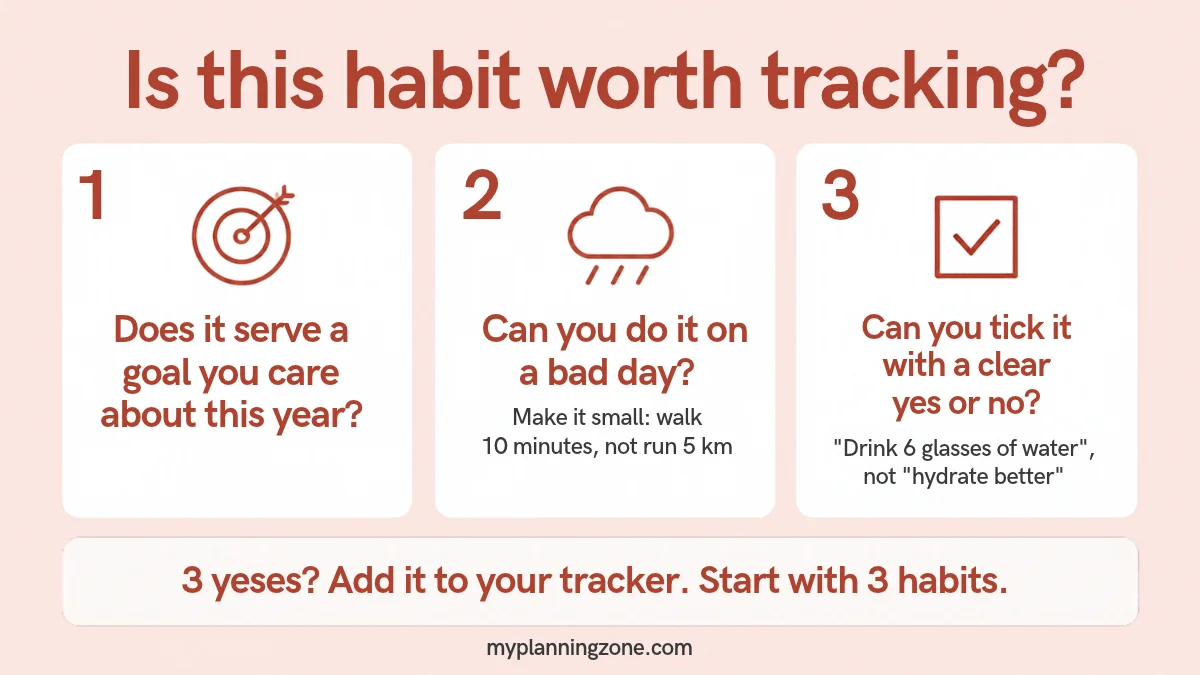
- Does it serve a goal you care about this year? If you can’t link a habit to something you want (more energy, less debt, a calmer home), skip it. Our guide to setting New Year goals you’ll keep helps you pick those goals first.
- Can you do it on a bad day? “Run 5 km” fails the first time you’re tired. “Put on running shoes and walk 10 minutes” survives. Small versions keep the streak alive, which is the idea behind the 2-minute rule.
- Can you answer “did I do it?” with a clear yes or no? “Drink 6 glasses of water” is trackable. “Hydrate better” isn’t.
Start with 3 habits, not 15. Once all three feel easy for a few weeks, add one more.
Daily habits to track
These are the good daily habits to track, grouped by area so you can pick one or two from the parts of life you most want to improve.
Health and body
- Walk or move for 20 to 30 minutes
- Get 7 or more hours of sleep
- Go to bed at the same time
- Drink your water target
- Eat a vegetable or fruit with every meal
- Stretch for 5 minutes
- Take the stairs instead of the lift
- No caffeine after 2 p.m.
- Pack a healthy lunch
- Floss
For movement and sleep, use official targets rather than guesses: the CDC says adults need 150 minutes of moderate activity a week (for example, 30 minutes on 5 days) and that adults aged 18 to 60 need 7 or more hours of sleep a night.
Mind and mood
- Write 3 things you’re grateful for
- Journal for 5 minutes
- Meditate or breathe slowly for 5 minutes
- Get 10 minutes of daylight outside
- Rate your mood (1 to 5)
- No phone for the first 30 minutes after waking
- Screen-free hour before bed
- Do one thing just for fun
New to journaling? Start with our guide on how to start journaling.
Productivity and work
- Plan tomorrow before you stop working
- Pick your top 3 tasks for the day
- Do one deep work block (60 to 90 minutes, no notifications)
- Inbox to zero (or under 10)
- Finish your most important task before lunch
- Clear your desk at the end of the day
- Do a 2-minute brain dump
- Check your calendar for tomorrow
- Stop work at your set time
Money
- Log every purchase
- No-spend day
- Pack lunch instead of buying it
- Transfer a set amount to savings
- Check your bank balance
- Wait 24 hours before any non-essential purchase
Logging spending is the habit most budgets depend on. See how to track your expenses for five easy ways to do it.
Home
- Make your bed
- Kitchen cleared before bed
- One load of laundry, start to finish
- 10-minute tidy
- Declutter one item
- Water the plants
- Prep tomorrow’s clothes and bag
Relationships
- Text or call one friend or family member
- Eat one meal together without phones
- Give one genuine compliment
- 15 minutes of one-on-one time with your child or partner
- Read a bedtime story
Learning and creativity
- Read 10 pages
- Practice a language for 10 minutes
- Write 200 words
- Practice an instrument
- Learn one new thing and write it down
- Listen to an educational podcast or audiobook
Weekly habits to track
Some habits don’t need to happen every day. Track these once or twice a week:
- Plan your week (our 30-minute Sunday routine shows how)
- Meal plan and write a grocery list
- Strength training on 2 days (the CDC also recommends muscle-strengthening activity at least 2 days a week)
- Review your budget
- Change the bed sheets
- Deep clean one room
- Call a parent or grandparent
- Date night or a family outing
- Back up your phone and files
- Try a new recipe
- Go somewhere in nature
- Do a weekly review: what worked, what didn’t
Monthly habits to track
- Pay off or check one debt
- Review subscriptions and cancel one you don’t use
- Declutter one drawer, shelf or cupboard
- Read one book
- Review your goals and progress
- Do something new (a class, a trail, a museum)
Bad habits to track (and break)
You can also track the days you avoided a habit you want to drop. Mark a “yes” for each day you stayed clear:
- No social media scrolling in bed
- No takeout
- No snoozing the alarm
- No impulse online shopping
- No sugary drinks
- No working past your stop time
To replace a bad habit rather than just resist it, read our step-by-step guide on how to change your habits.
Starter habit sets for different routines
If you don’t know where to begin, borrow one of these 3-habit sets and adjust it:
| Routine | Habit 1 | Habit 2 | Habit 3 |
|---|---|---|---|
| Busy parent | 10-minute tidy | Plan tomorrow before bed | 15 minutes one-on-one with each child |
| Student | Read 10 pages | One deep work block | Phone away 1 hour before bed |
| Working professional | Top 3 tasks each morning | Stop work at your set time | Walk 20 minutes |
| Money reset | Log every purchase | No-spend day (twice a week) | Weekly budget review |
| Fresh start for the New Year | Make your bed | Drink your water target | Write 3 things you’re grateful for |
How to set up a habit tracker that you’ll keep using
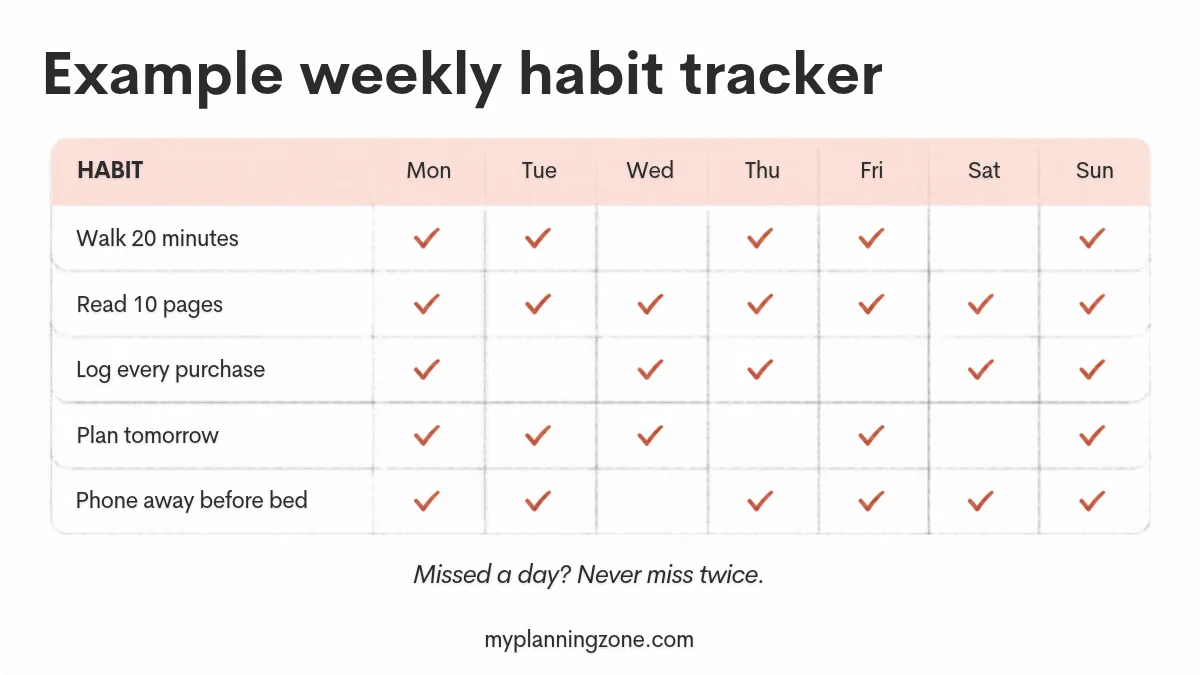
- Write each habit as a small, checkable action. Add a number or time: “Read 10 pages”, not “read more”.
- Choose your format. A printed tracker or planner page is hard to ignore. An app sends reminders. A bullet journal lets you design your own layout. Pick one, not all three.
- Link each habit to a cue. “After I pour my coffee, I write my top 3 tasks.” Tying a new habit to something you already do every day makes it easier to remember.
- Put the tracker where you’ll see it. On the fridge, next to your bed, or on the first page of your planner. Our guide on how to use a planner shows where trackers fit in a weekly setup.
- Tick the box straight away. Mark it as soon as you finish, not at night from memory.
- Review once a week. Look for patterns: which days you miss, and why. Make a habit smaller if you keep missing it.
Daily, weekly or monthly tracker?
- Daily tracker: best for habits you do every day (water, sleep, reading). A one-page monthly grid with days across the top works well.
- Weekly tracker: best for beginners and for habits like workouts or meal planning. Seven boxes feel more achievable than thirty.
- Monthly or yearly tracker: best for spotting long-term patterns, such as a “year in pixels” page where you color each day by mood.
What research says about tracking habits
Two findings are worth knowing before you start:
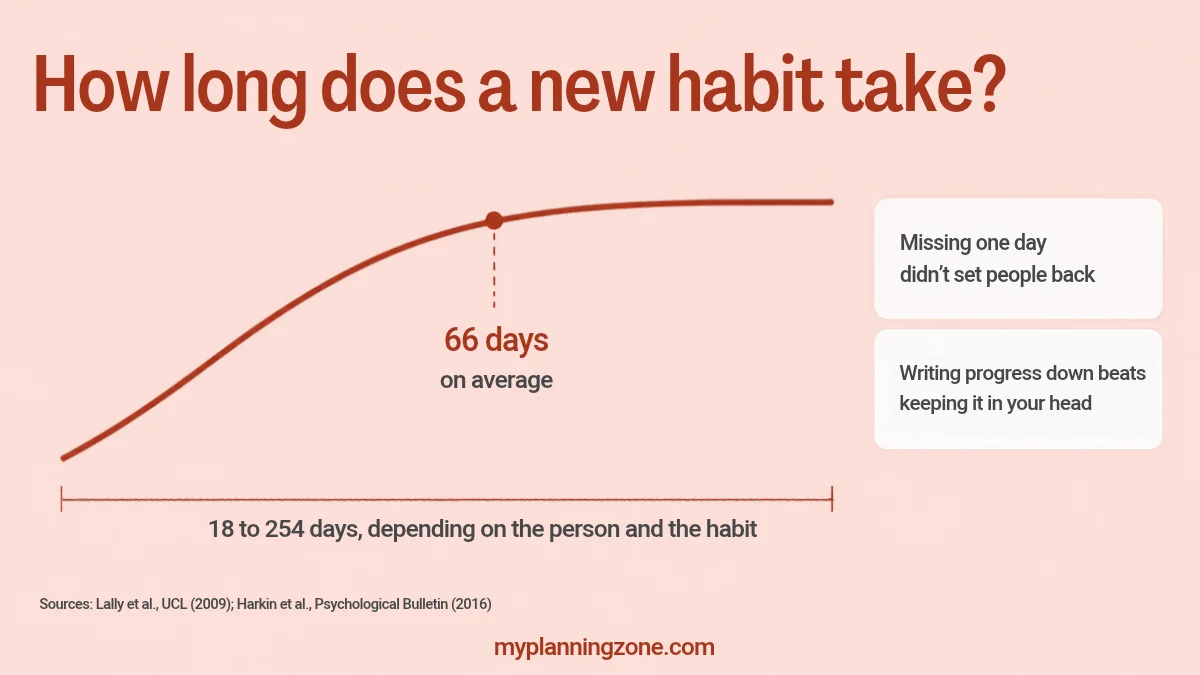
- Habits take longer than 21 days. In a University College London study led by Phillippa Lally, it took participants an average of 66 days for a daily behavior to become automatic, and the time ranged from 18 to 254 days depending on the person and the habit. The same research found that missing one day didn’t significantly set people back. Being very inconsistent did.
- Writing your progress down helps. A 2016 meta-analysis of 138 studies in Psychological Bulletin (Harkin and colleagues) found that monitoring goal progress improves the chance of reaching a goal, and that progress which was physically recorded had a bigger effect than progress that was only noted mentally.
In practice: give each new habit at least two months, don’t panic over a missed day, and keep your tracker on paper or in an app rather than in your head.
Common habit tracker mistakes
- Tracking too many habits. Ten new habits at once is a recipe for an empty grid. Three is plenty.
- Vague habits. If you can’t tick it with a clear yes or no, rewrite it.
- All-or-nothing streaks. One missed day isn’t failure. Use the rule “never miss twice” instead.
- Never reviewing. The tracker shows you patterns only if you look at it each week.
- Decorating instead of doing. A pretty layout is fine, but it shouldn’t take longer than the habits.
A printable tracker for every habit on this list
If you prefer paper, our Yearly Trackers Bundle includes a habit tracker plus sleep, fitness, mood-in-pixels, year-in-pixels and annual goals trackers. The pages are undated, so you can start any month, and they print in A4, A5 and US Letter.
Frequently asked questions
What are good habits to track?
Good habits to track support a goal you care about, are small enough to do on a bad day, and can be ticked with a clear yes or no. Popular examples are getting 7 or more hours of sleep, walking 20 to 30 minutes, reading 10 pages, logging every purchase and planning tomorrow before you stop work.
How many habits should I track at once?
Start with three. Tracking too many new habits at once is the most common reason a tracker ends up empty. When all three feel easy for a few weeks, add one more.
Should I track habits daily or weekly?
Track daily habits (water, sleep, reading) on a daily grid, and habits you do a few times a week (workouts, meal planning, budget reviews) on a weekly tracker. Beginners often find a weekly tracker easier because seven boxes feel more achievable than thirty.
How long does it take to build a habit?
Longer than the popular 21 days. In a University College London study, a daily behavior took 66 days on average to become automatic, with a range of 18 to 254 days depending on the person and the habit. Missing a single day did not significantly slow people down.
What should I put in a bullet journal habit tracker?
List 3 to 6 habits down the side and the days of the month across the top, then shade or tick each box as you go. Good bullet journal habits to track include reading, water, movement, a no-spend day, a mood rating and a screen-free hour before bed.
Pick your 3 habits today
Choose three habits from the list, run them through the 3-question test, and write them on a tracker you’ll see every day. Review them each Sunday. Once they feel automatic, add the next one. For more ideas on which habits make the biggest difference, see the best habits to have.