

Most people set New Year goals with good intentions and quit by February. The problem usually isn’t willpower. It’s that the goals are vague, there are too many of them, and they’re written as things to stop doing rather than things to start.
This guide walks you through a simple five-step method for setting new year goals for 2027 that you’ll actually keep, plus goal ideas for every area of life, examples you can copy, and a monthly check-in routine so January’s plan is still alive in June.
In this guide
Why most New Year goals fail (and what the research says)
The good news first: resolutions can work. In a one-year study of 1,066 people published in PLOS ONE, 55% of participants considered themselves successful at the one-year follow-up.
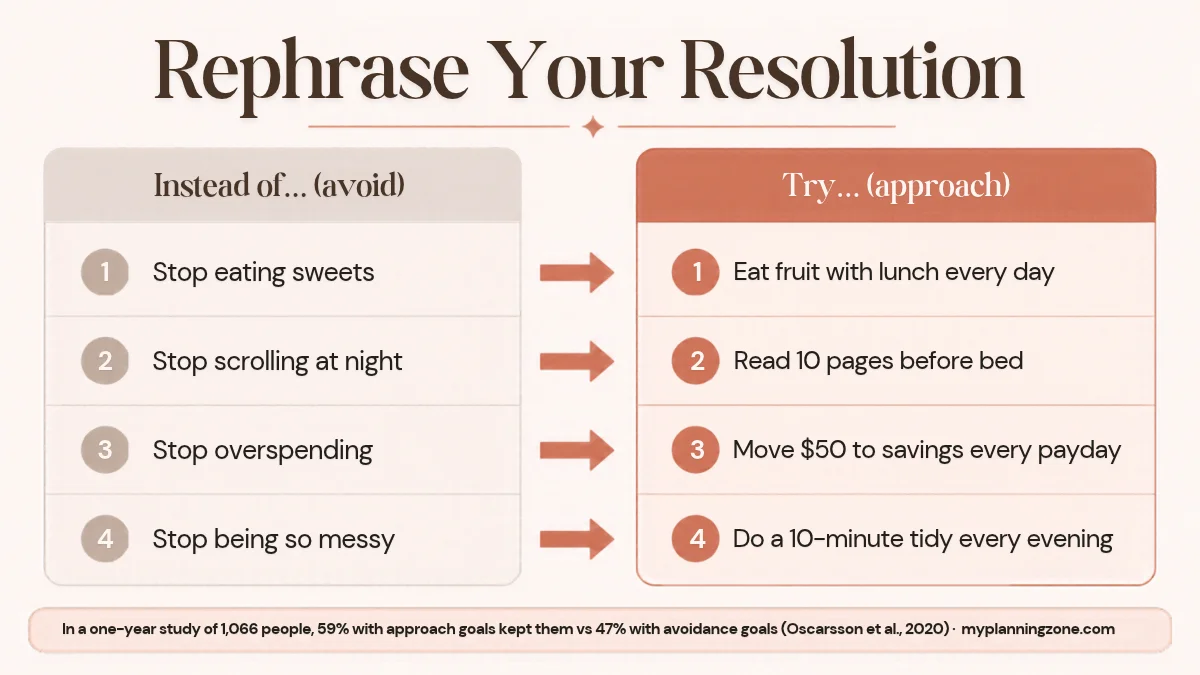
The same study found something useful about how you phrase a goal. People with approach goals (starting or adding something) succeeded more often than people with avoidance goals (quitting or avoiding something): 58.9% versus 47.1%.
A second body of research helps with the other big problem, which is actually starting. A meta-analysis of 94 studies by Gollwitzer and Sheeran found that simple “if-then” plans (called implementation intentions) had a medium-to-large positive effect on reaching goals.
So the recipe is not complicated: fewer goals, phrased as things to start, with a concrete plan for when and where you’ll act.
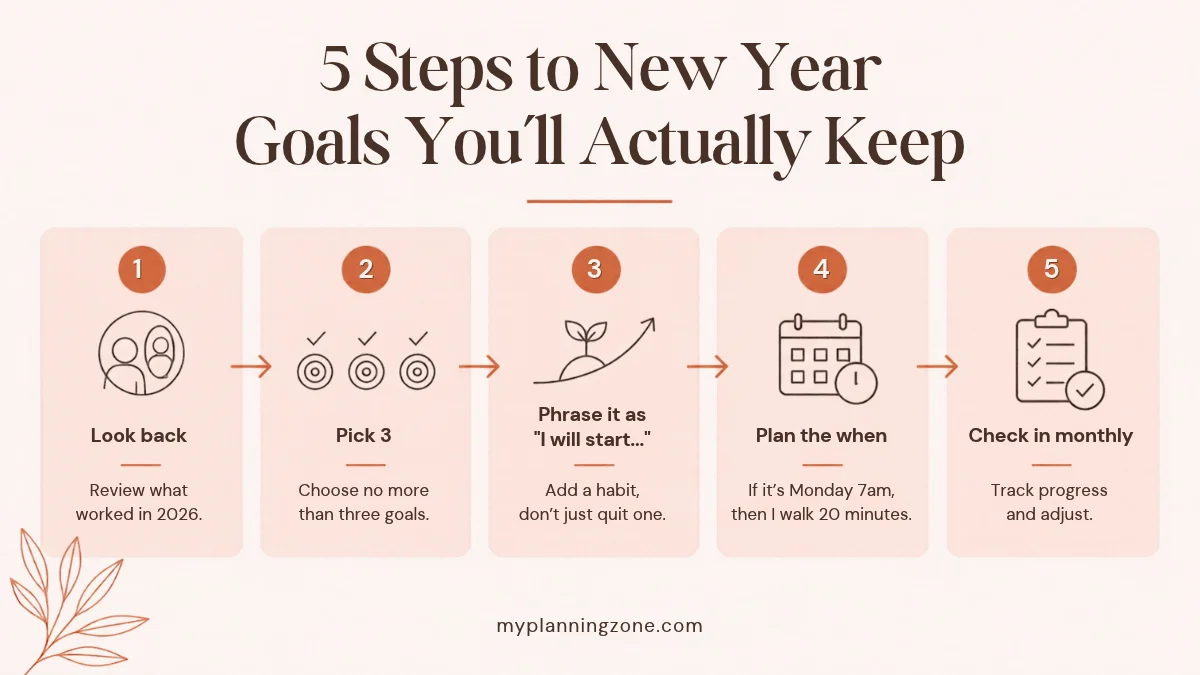
Step 1: Look back before you look ahead
Before you write anything for 2027, spend 20 minutes reviewing 2026. Your best goals usually come from patterns you already lived through, not from a list of what other people are doing.
Answer these four questions on paper:
- What went well this year, and why?
- What drained my time, money or energy?
- Which goal from last year did I drop, and what got in the way?
- If next year went perfectly, what would be different by December?
Circle anything that shows up more than once. Those repeating themes are your strongest candidates for next year. For a deeper version, use our end of year review with 60 reflection questions.
Step 2: Pick no more than three goals
Every goal competes for the same limited time and attention. Ten goals usually means ten half-efforts. Three goals means you can give each one real weekly time.
A simple way to choose: give each candidate a score from 1 to 5 for impact (how much it would improve your life) and readiness (how ready you are to work on it now). Keep the three with the highest combined score. Park the rest on a “later” list you can revisit in April or July.
Try to spread your three across different life areas, for example one health goal, one money goal and one personal goal, so one area doesn’t take over the whole year.
Step 3: Phrase each goal as something to start
This is the easiest change you can make, and it’s backed by the study above. Instead of a goal that removes something, write one that adds a replacement behavior.
| Avoidance goal (harder) | Approach goal (easier to keep) |
|---|---|
| Stop eating sweets | Eat fruit with lunch every day |
| Stop scrolling at night | Read 10 pages before bed |
| Stop overspending | Move $50 to savings every payday |
| Stop being so messy | Do a 10-minute tidy every evening |
| Stop procrastinating | Start each workday with my most important task |
Then make it specific and measurable. “Get fit” becomes “walk 20 minutes, five days a week.” “Save more” becomes “save $1,300 by December 31.” If you like frameworks, this is where the SMART goal method fits in.
Step 4: Plan the when and where (if-then plans)
A goal tells you what you want. An if-then plan tells you exactly when you’ll act, so you don’t have to decide every day. Use this format:
“If it’s [time or situation], then I will [specific action].”
- If it’s Monday, Wednesday or Friday at 7 a.m., then I’ll walk for 20 minutes before breakfast.
- If it’s payday, then I’ll transfer $50 to my savings account before I pay anything else.
- If I sit down on the couch after dinner, then I’ll set a 10-minute timer and tidy the living room first.
Add one “obstacle plan” for each goal too: “If it’s raining, then I’ll do a 15-minute workout video at home.” Planning for the likely problem in advance is what keeps a bad week from ending the whole goal.
Finally, put these plans where you’ll see them: in your calendar, on your fridge or in your planner. If you want a ready-made layout, our Printable Goal Planner includes SMART goal worksheets, action plans and reflection pages for exactly this step.
Step 5: Check in every month
Most goals don’t fail in one dramatic moment. They fade quietly because nobody looks at them after January. A 15-minute monthly check-in fixes that.
On the last Sunday of each month, ask:
- Did I do what my if-then plans said? Roughly what percentage of the time?
- What got in the way most often?
- Does anything need to get smaller, easier or rescheduled?
- What’s my plan for next month?
Adjusting a goal is not failing. Shrinking “walk 5 days a week” to “walk 3 days a week” in March is far better than quitting in March. A simple monthly planning routine makes this check-in easy to remember.
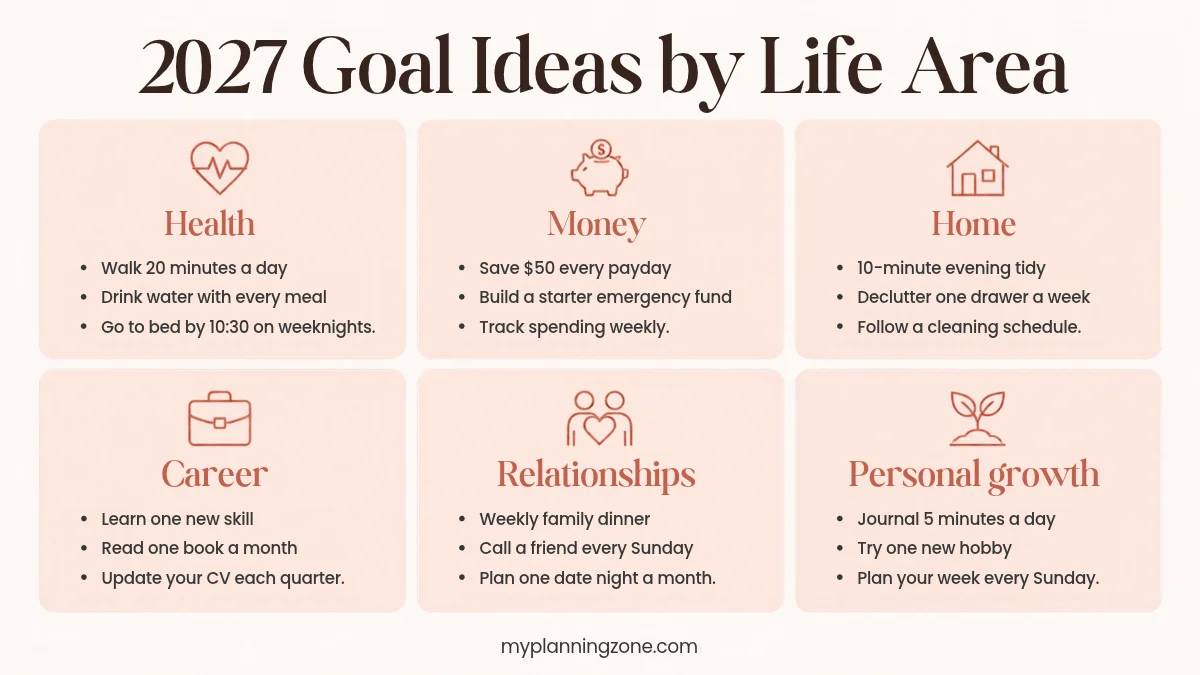
New Year goal ideas for 2027 by life area
Use these as starting points, not a checklist. Pick the ones that match what came up in your Step 1 review, then rewrite them in your own words.
Health and wellness goals
- Walk 20 minutes a day, five days a week
- Drink a glass of water with every meal
- Go to bed by 10:30 p.m. on weeknights
- Cook at home four nights a week
- Try one new type of exercise each quarter
Money goals
- Save $50 every payday
- Build a starter emergency fund
- Track spending once a week
- Plan next December’s holiday budget in January
- Complete a structured savings challenge for 2027
Home and organization goals
- Do a 10-minute tidy every evening
- Declutter one drawer or shelf each week
- Follow a weekly cleaning schedule
- Plan meals every Sunday
- Set up a family chore system
Career and learning goals
- Learn one new skill and finish one course
- Read one book a month
- Update your CV or portfolio every quarter
- Block one hour a week for deep work on a big project
Relationship and family goals
- Have a weekly family dinner with no phones
- Call a friend or relative every Sunday
- Plan one date night a month
- Set shared goals as a family (see our guide to setting family goals)
Personal growth goals
- Journal for five minutes each day
- Try one new hobby this year
- Plan your week every Sunday evening
- Make a vision board for the year
3 examples of complete New Year goals
Here’s what a fully planned goal looks like when you put all five steps together.
Example 1: Health
Goal: Walk 20 minutes, five days a week, all year.
If-then plan: If it’s a weekday at 12:30 p.m., then I’ll walk around the block before lunch.
Obstacle plan: If it’s raining, then I’ll walk indoors with a video.
Tracking: Tick a box on my habit tracker each day.
Example 2: Money
Goal: Save $1,300 by December 31, 2027.
If-then plan: If it’s payday, then I’ll move $50 to savings before paying anything else.
Obstacle plan: If a bill is due the same day, then I’ll move $25 now and $25 next payday.
Tracking: Color in a savings tracker after each transfer.
Example 3: Home
Goal: Keep the main living areas tidy every evening.
If-then plan: If dinner dishes are done, then I’ll set a 10-minute timer and reset the living room.
Obstacle plan: If I’m exhausted, then I’ll do a two-minute version and clear one surface.
Tracking: Mark it off on my weekly planner.
How to track your goals all year
Tracking turns a goal into something you can see. It doesn’t need to be complicated.
- Habit tracker: one row per daily habit, one box per day. Best for health and home goals.
- Progress bar or thermometer: best for numeric goals like savings or books read.
- Year in pixels: color one square per day for mood or energy, so you spot patterns over months.
- Monthly review page: a short written note after each check-in (Step 5).
If you’d rather print than build your own, our Yearly Trackers Bundle includes annual goals, habit, mood-in-pixels, sleep and fitness trackers on one set of pages. For building the habits themselves, see our guide on how to change your habits.
Keep reading: How to Use a Planner in 2027: Set It Up in 9 Steps
Frequently asked questions
How many New Year goals should I set?
Three is a good maximum for most people. Each goal needs regular weekly time and attention, so fewer goals usually means more progress. Keep any extra ideas on a “later” list and revisit them at a quarterly check-in.
What is the difference between a New Year resolution and a goal?
A resolution is usually a general intention, like “be healthier.” A goal is specific and measurable, like “walk 20 minutes, five days a week.” Turning resolutions into goals with a clear plan for when and where you will act makes them much easier to keep.
When should I start setting goals for 2027?
Late November or December is ideal. It gives you time to review the year, choose your goals calmly and set up your planner or trackers before January 1, instead of deciding everything on New Year’s Eve.
What should I do if I fall behind on my goals?
Shrink the goal instead of quitting it. Cut the frequency or size in half, reschedule your if-then plan to a more realistic time and restart the next day. Use your monthly check-in to adjust rather than to judge yourself.
What are good New Year goals for beginners?
Pick small, daily actions you can start right away: a 10-minute walk, a 10-minute evening tidy, saving a fixed amount every payday or reading 10 pages before bed. Small wins build the consistency you need for bigger goals later.
Your next step
Don’t wait for January 1. Block 30 minutes this week to do your Step 1 review and choose your three goals. Write one if-then plan for each, and put your first monthly check-in in your calendar for the last Sunday of January.
A small, specific plan you start now beats a big, vague resolution you make at midnight.