
An end of year review is one of the most useful hours you can spend in December. Before you set new goals, it shows you what actually worked this year, what drained you and what you want to carry into next year.
Below you’ll find a simple one-hour review process, a quick way to score each area of your life, and 60 end of year reflection questions grouped by topic. Pick the questions that fit you; you don’t need to answer all 60.
In this guide
Why an end of year review is worth an hour
We remember the last few weeks and the biggest moments, and forget most of the rest. A structured review fixes that by making you look at the whole year on paper.
Reflection also helps you learn from experience. In a field study of new call-center employees, those who spent 15 minutes at the end of each training day reflecting on what they had learned scored about 23% higher on their final assessment than those who didn’t. A year-end review applies the same idea to your whole year.
Most importantly, your review gives you real material for next year’s plan, instead of resolutions picked out of thin air.
How to do an end of year review in 1 hour
Block one hour in late November or December, put your phone on silent and grab a notebook or planner. Then follow these five steps.
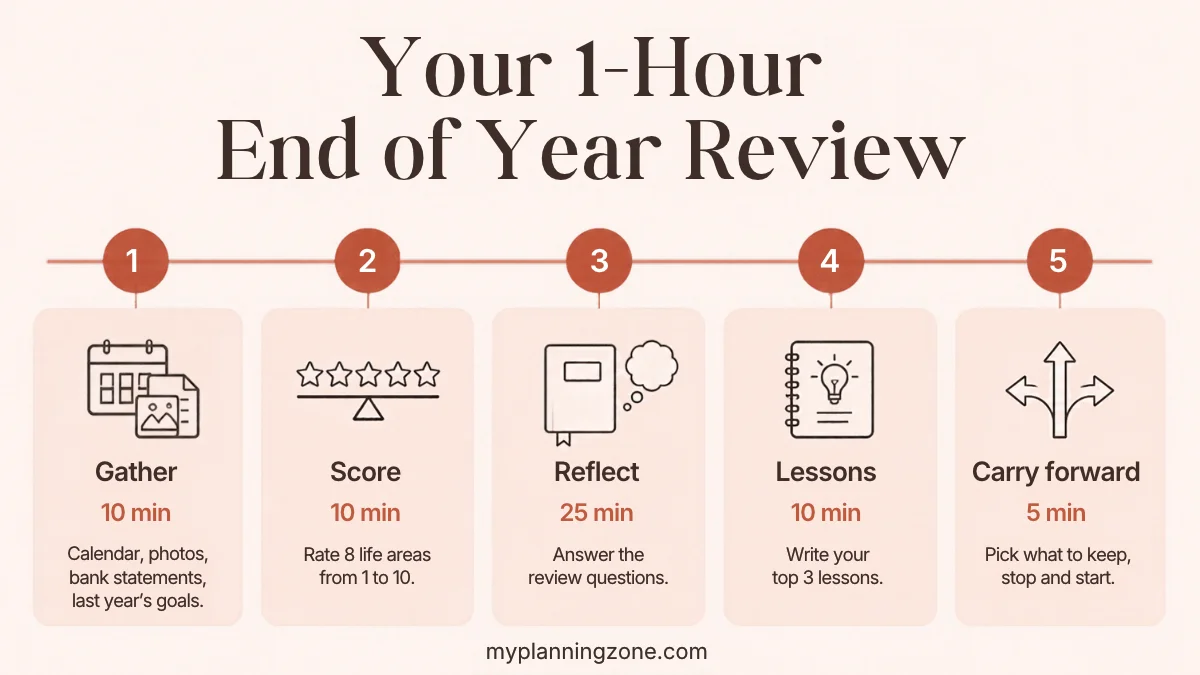
- Gather (10 minutes). Open your calendar, photo roll, bank or budget app and last year’s goals. Scroll month by month and jot down the main events, wins and tough moments.
- Score (10 minutes). Rate each life area from 1 to 10 (see the scorecard below).
- Reflect (25 minutes). Answer 10 to 20 of the questions below. Write in full sentences; it makes your thinking clearer.
- Lessons (10 minutes). Read your answers and write your top three lessons from the year.
- Carry forward (5 minutes). Decide what to keep, stop and start next year.
Short on time? Do steps 2 and 5 only. Even a 15-minute version is better than skipping the review entirely.
Score your year: the life area check
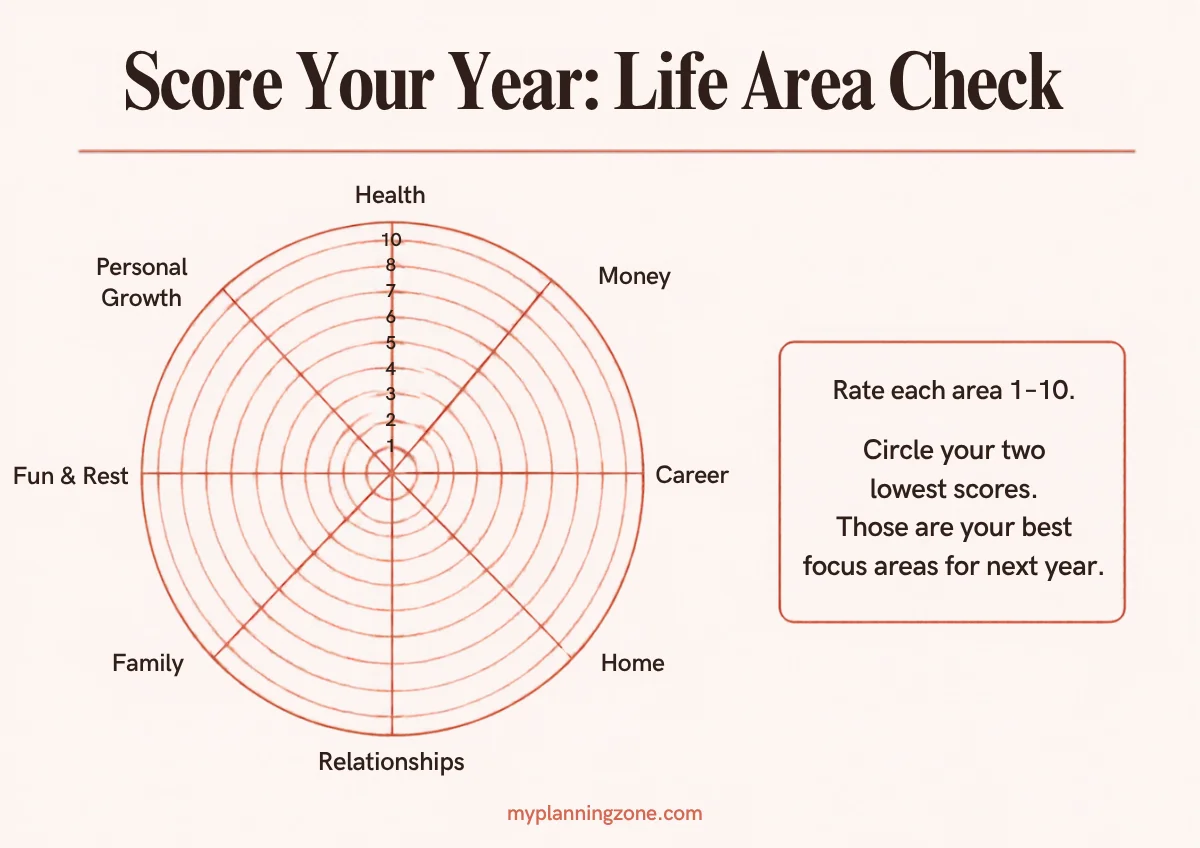
Before the questions, give each area of your life a quick score from 1 (very unhappy) to 10 (couldn’t be better). Don’t overthink it; go with your first instinct.
| Life area | What to think about | Score (1 to 10) |
|---|---|---|
| Health | Energy, sleep, movement, eating | |
| Money | Saving, spending, debt, peace of mind | |
| Career or studies | Progress, learning, satisfaction | |
| Home | Organization, routines, comfort | |
| Relationships | Partner, friends, community | |
| Family | Time together, shared plans | |
| Fun and rest | Hobbies, travel, downtime | |
| Personal growth | Habits, confidence, new skills |
Circle your two lowest scores. Those areas usually make the best focus for next year’s goals.
60 end of year review questions
The questions are grouped into six areas. Start with the section that matches your lowest score, then move on to the others if you have time.
The year overall (questions 1 to 10)
- If I had to describe this year in one word, what would it be?
- What am I most proud of this year?
- What were my three biggest wins, big or small?
- What was the hardest moment, and how did I get through it?
- Which goals from last year did I reach, and which did I drop?
- What surprised me most this year?
- What did I spend too much time on?
- What did I not spend enough time on?
- What was the best decision I made this year?
- What is one thing I would do differently if I could repeat the year?
Health and wellbeing (questions 11 to 20)
- How was my energy most days?
- Did I get enough sleep? What helped or got in the way?
- How did I move my body this year, and what did I enjoy most?
- Which healthy habit stuck best?
- Which healthy habit did I keep restarting?
- How did I handle stress most of the time?
- When did I feel calmest and most rested?
- What drained my energy the most?
- Did I take real breaks, days off or holidays?
- What one change would make the biggest difference to my wellbeing next year?
Money (questions 21 to 30)
- Did I save more or less than I planned?
- What was my best money decision this year?
- What purchase am I happiest about?
- What purchase do I regret?
- Where did my money go each month, roughly?
- Did I stick to a budget? If not, where did it break down?
- Do I have an emergency fund, and is it big enough?
- Did I reduce any debt?
- How stressed did I feel about money, from 1 to 10?
- What is one money habit I want to start next year?
Work, studies and learning (questions 31 to 40)
- What was my biggest achievement at work or school?
- What new skill did I learn?
- What did I enjoy most about my work or studies?
- What drained me most?
- Who helped me grow this year?
- Did my work match my priorities and values?
- What did I procrastinate on, and why?
- Which books, courses or podcasts made the biggest impact?
- What feedback did I receive that I should act on?
- Where do I want to be at work or school by the end of next year?
Relationships, family and home (questions 41 to 50)
- Who did I spend the most time with this year?
- Which relationships grew stronger?
- Who do I want to see more of next year?
- What was my favorite family or friends memory this year?
- Did I say yes to too many things, or too few?
- How organized and calm did my home feel most weeks?
- Which home routine worked well (cleaning, meals, laundry)?
- Which part of the house or routine caused the most stress?
- How were household tasks shared?
- What would make our home run more smoothly next year?
Looking ahead (questions 51 to 60)
- What do I want more of next year?
- What do I want less of?
- What do I want to stop doing completely?
- What lesson from this year do I want to remember?
- Which area of my life deserves the most attention next year?
- What is one thing I’m excited to try?
- What would make next year a great year, in one sentence?
- What support or tools will I need?
- What could get in my way, and how will I handle it?
- What is the first small step I can take in January?
Turn your answers into next year’s plan
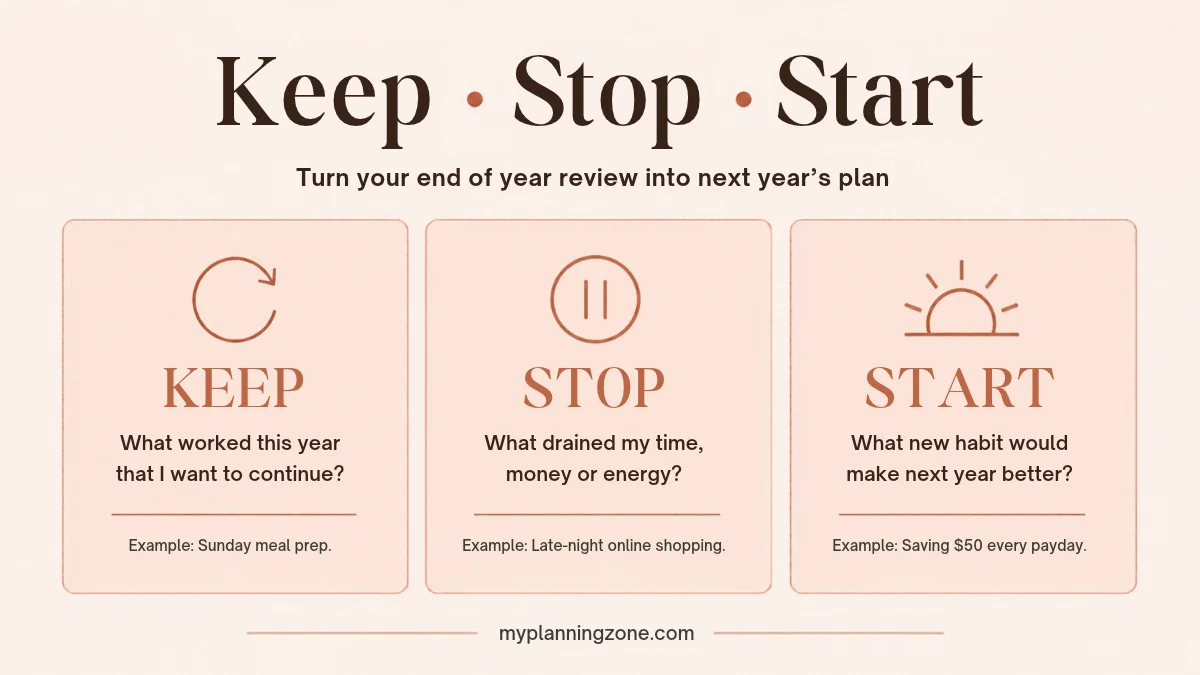
A review is only useful if it changes something. Finish with a simple keep, stop, start list:
- Keep: what worked that you want to continue (for example, Sunday meal prep).
- Stop: what drained your time, money or energy (for example, late-night online shopping).
- Start: one new habit that would make next year better (for example, saving $50 every payday).
Your “start” items and your two lowest-scoring life areas are the raw material for next year’s goals. Our step-by-step guide to setting New Year goals you’ll actually keep shows you how to turn them into specific goals with a clear plan.
If you’d like everything on paper, our Printable Goal Planner includes reflection and goal-planning pages, and the Yearly Trackers Bundle lets you track habits, mood and annual goals across the new year.
Doing your review in late December? Our week-by-week Christmas to-do list helps you clear the holiday tasks first, so you have a quiet hour to reflect.
Tips to make your review easier
- Schedule it. Put it in your calendar like an appointment. The week between Christmas and New Year works well for many people.
- Use your data. Your calendar, photos and bank statements remember the year better than you do.
- Be kind to yourself. The point is to learn, not to judge. Write down wins before problems.
- Do it with someone. Partners, friends or family can answer a few questions together over dinner.
- Keep your answers. Save them in your planner so next December you can compare two years side by side.
- Add a monthly mini-review. A 15-minute check-in each month makes the year-end review much faster. See our guide to planning your month.
Keep reading: How to Use a Planner in 2027: Set It Up in 9 Steps
Frequently asked questions
What is an end of year review?
An end of year review is a short, structured look back at the past 12 months. You review what happened, score how each area of your life went, answer reflection questions and decide what to keep, stop and start next year.
When should I do my end of year review?
Any time from late November to the first week of January works. Many people like the quiet week between Christmas and New Year. Doing it before you set New Year goals gives you better material to plan with.
How long does an end of year review take?
About one hour is enough for a thorough personal review. If you are short on time, a 15-minute version works: score your life areas and write a quick keep, stop, start list.
How many reflection questions should I answer?
Ten to twenty is plenty. Start with the section that matches your lowest-scoring life area and choose the questions that feel most useful. You do not need to answer all 60.
Can I do a year-end review with my family or partner?
Yes. Pick five to ten questions from the “year overall” and “relationships, family and home” sections and answer them together over a meal. It is a simple way to share highlights and agree on plans for next year.
Your next step
Choose a date for your review now and block one hour. On the day, score your eight life areas, answer at least 10 questions and finish with your keep, stop, start list. You’ll walk into January with a plan built on your own year, not someone else’s resolutions.