

Most budgets don’t fail because the math is hard. They fail because they’re built on guesses, they have no room for real life, and nobody looks at them again after the first week.
This guide shows you how to make a budget that works with your actual income and spending. You’ll get 7 simple steps, a comparison of the most popular budgeting methods, a sample $4,000 monthly budget, and a checklist of categories so nothing gets forgotten. It’s written for beginners, and you can set it all up in one evening.
In this guide
What is a budget (and why start in January)?
A budget is a plan for your money, written down before the month starts. It shows how much comes in, where it goes, and how much is left for your goals. As the FTC’s consumer.gov guide to making a budget puts it, a budget helps make sure you’ll have enough money every month, so you don’t run out before your next paycheck.
You can start a budget any month, but January makes it easier. Holiday spending is behind you, many annual bills reset, and a fresh year gives you a clean 12 months to track. If you start on January 1, your first full-year budget is ready to review next December.
How to make a budget in 7 steps
Here’s the whole process at a glance. Each step is explained below.
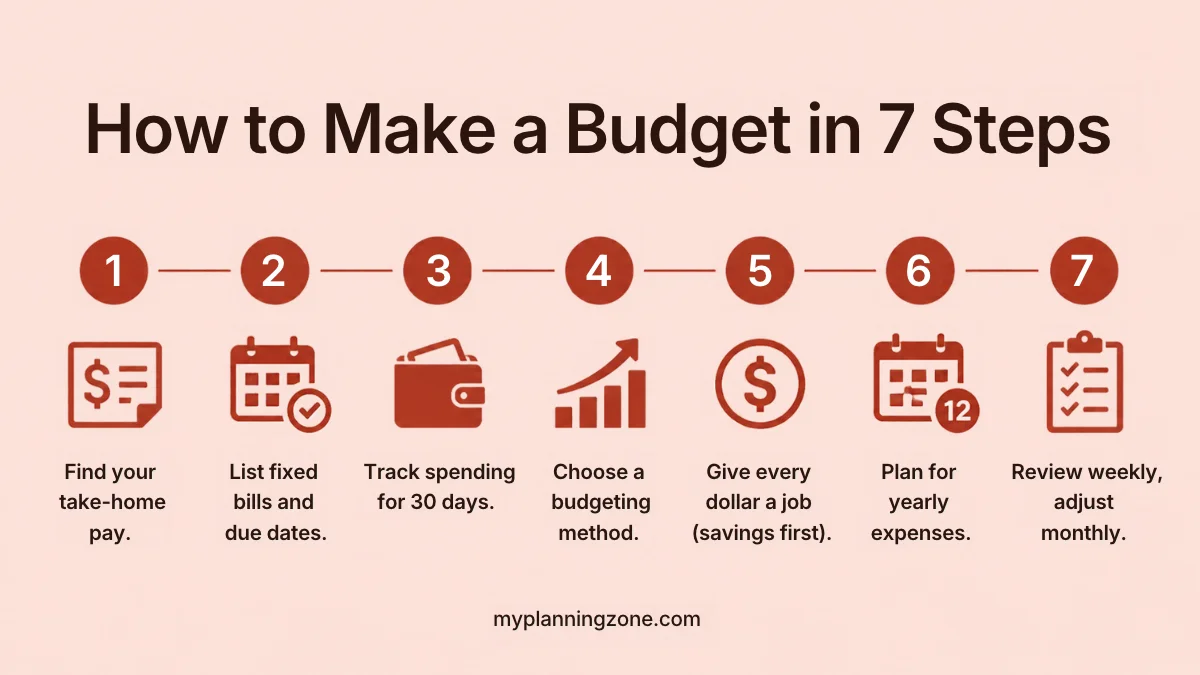
Step 1: Find your monthly take-home pay
Start with what actually lands in your bank account each month, after taxes and deductions. Add up every source: your paycheck, a partner’s income, side work, child support or benefits.
- Paid every two weeks? Budget for two paychecks a month. Two months a year you’ll get a third one, which you can send straight to savings or debt.
- Irregular income? Add up what you earned last year and divide by 12 for a monthly estimate, then budget from your lowest typical month to stay safe.
Our guide on how to plan your paycheck shows how to split each payday when your bills fall at different times of the month.
Step 2: List your fixed bills and their due dates
Write down every bill that stays about the same each month: rent or mortgage, utilities, phone, internet, insurance, car payment, loan minimums, childcare and subscriptions. Add the due date next to each one.
Due dates matter more than most beginners expect. The Consumer Financial Protection Bureau points out that end-of-month shortfalls often happen because bills are due at different times than your income arrives, even when the monthly totals look fine.
Step 3: Track your spending for 30 days
Your budget is only as good as your numbers. Before you set limits for groceries, gas or eating out, find out what you really spend. Go through the last month of bank and card statements, or track every purchase for the next 30 days.
Sort each expense into a category and total them up. Most people find two or three categories that are much higher than they guessed. Our guide to tracking your expenses includes 5 methods and a 30-day plan.
Step 4: Choose a budgeting method
A method is simply the rule you use to divide your income. The right one depends on how much detail you want. The 50/30/20 rule is the easiest place to start, while a zero-based budget gives you the most control. Compare the main options in the table in the next section.
Step 5: Give every dollar a job, starting with savings
Now fill in your plan for next month. Work in this order:
- Essentials: housing, utilities, food, transportation, insurance and minimum debt payments.
- Savings: decide a fixed amount and move it on payday, before you spend anything else. This is called “paying yourself first.”
- Extra debt payments, if you’re paying something down.
- Wants: eating out, shopping, hobbies and entertainment, with whatever is left.
Your income minus all of these should equal zero or more. If it’s below zero, go back to your wants first, then your variable essentials like groceries.
Step 6: Plan for irregular and yearly expenses
Car repairs, annual subscriptions, back-to-school costs, birthdays and Christmas aren’t monthly, but they’re not surprises either. They’re the most common reason a budget “breaks” halfway through the year.
List every irregular expense you had last year, estimate the total, and divide by 12. Set that amount aside each month in a separate savings account (often called a sinking fund). For example, $900 of yearly costs means saving $75 a month. Our Christmas budget guide shows how to do this for holiday spending, and an emergency fund covers what you can’t predict.
Step 7: Review weekly and adjust monthly
Check your spending against your plan once a week. Ten minutes on a Sunday is enough to spot a category running over while there’s still time to fix it. At the end of the month, compare plan and reality, then adjust next month’s numbers.
Expect the first two or three months to be messy. That’s normal: you’re replacing guesses with real numbers. By month three, most budgets become much more accurate.
Which budgeting method should you use?
There’s no single best method. Pick the one that matches how much time you want to spend and how tight your money is.
| Method | How it works | Best for |
|---|---|---|
| 50/30/20 rule | 50% of take-home pay to needs, 30% to wants, 20% to savings and debt | Beginners who want a simple guideline |
| Zero-based budget | Every dollar is assigned a job until income minus spending equals zero | Tight budgets and maximum control |
| Envelope (cash stuffing) | Cash for each spending category goes into its own envelope; when it’s empty, you stop | Overspending on groceries, eating out or shopping |
| Pay yourself first | Savings come out on payday; you spend the rest freely | People who hate tracking details |
| Paycheck budget | Bills and savings are assigned to each paycheck based on due dates | Weekly or biweekly pay, or bills that bunch up |
The 50/30/20 rule was popularized by Elizabeth Warren and Amelia Warren Tyagi in their 2005 book All Your Worth. It’s a guideline, not a law. If your rent alone takes 40% of your income, try 60/20/20 or 70/20/10 and adjust as your situation improves. Our complete guide to the 50/30/20 rule has examples for five income levels and more alternatives.
Example: a $4,000 monthly budget
Here’s how the 50/30/20 rule could look for someone who takes home $4,000 a month. Your numbers will be different, but the structure is the same.
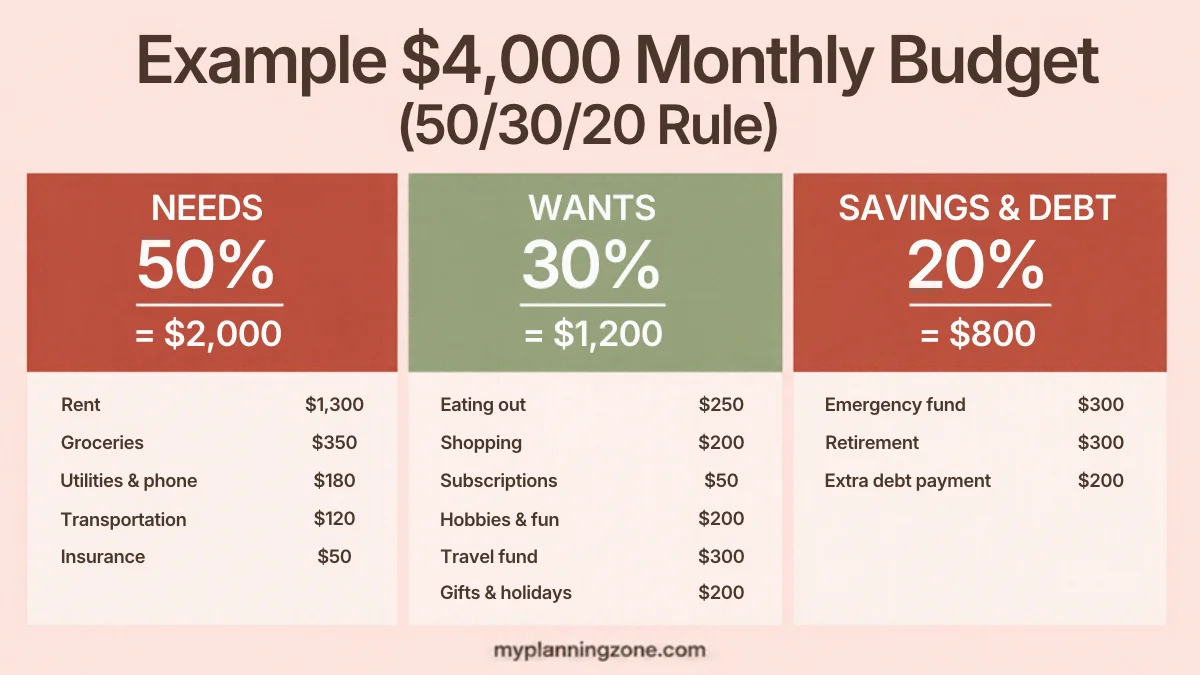
- Needs (50%): $2,000. Rent $1,300, groceries $350, utilities and phone $180, transportation $120, insurance $50.
- Wants (30%): $1,200. Eating out $250, shopping $200, subscriptions $50, hobbies and entertainment $200, travel fund $300, gifts and holidays $200.
- Savings and debt (20%): $800. Emergency fund $300, retirement $300, extra debt payment $200.
Notice that the gifts and travel lines are planned monthly. That’s Step 6 in action: by December, $2,400 is already waiting for the holidays.
Budget categories checklist
Use this list to make sure nothing is missing from your budget. Not every line will apply to you.
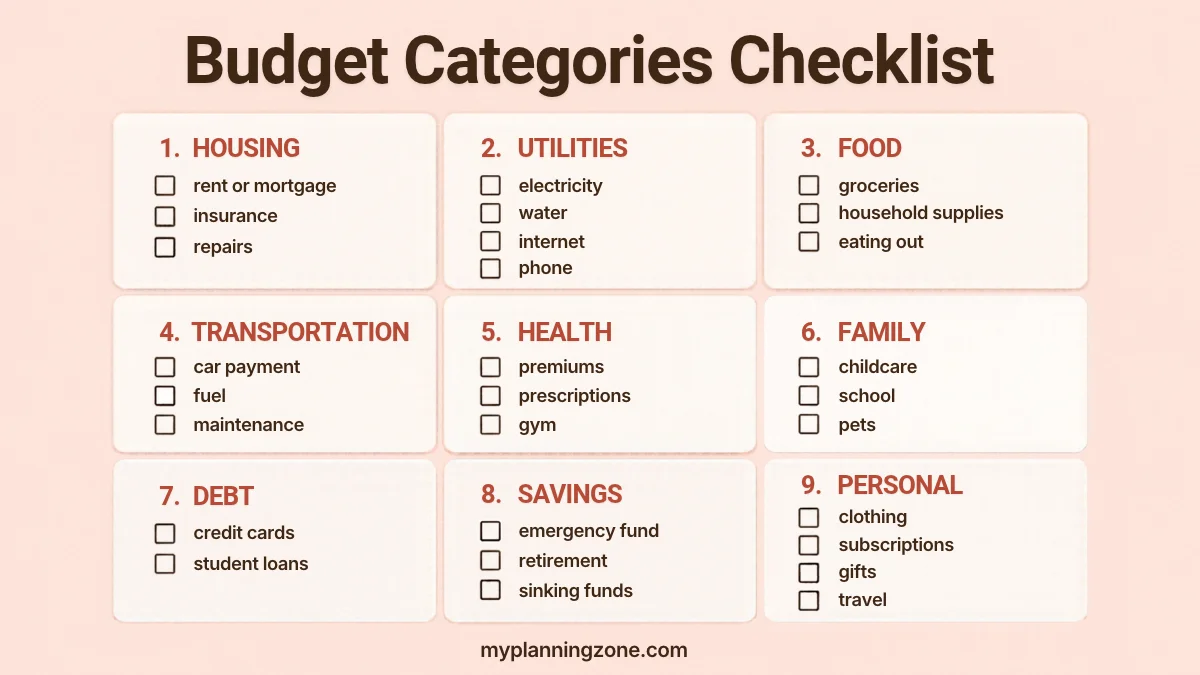
- Housing: rent or mortgage, property tax, HOA fees, repairs, renter’s or home insurance.
- Utilities: electricity, gas, water, trash, internet, phone.
- Food: groceries, household supplies, eating out, coffee and takeout.
- Transportation: car payment, fuel, insurance, maintenance, parking, public transit.
- Health: insurance premiums, prescriptions, copays, gym.
- Family: childcare, school costs, activities, pet care.
- Debt: credit cards, student loans, personal loans. Our guide to tracking your debt helps you list them all.
- Savings: emergency fund, retirement, sinking funds, big goals.
- Personal: clothing, haircuts, subscriptions, hobbies, gifts, travel.
How to stick to your budget
- Automate the important parts. Schedule your savings transfer and fixed bills for payday, so they happen before you can spend the money.
- Keep a small “miscellaneous” line. $50 to $100 for the things you forgot stops one surprise from wrecking the whole month.
- Plan your month before it starts. A short monthly reset makes budgeting part of your routine. Our guide on how to start your month walks you through it.
- Use a tracking method you’ll actually keep up with, whether that’s an app, a spreadsheet or a printed planner.
- Give yourself a goal. A budget is easier to follow when it’s paying for something you want, like a trip or being debt-free. The 2027 savings challenge is an easy way to start.
- Budget with your partner. If you share money, plan together once a month so nobody feels policed.
Common budgeting mistakes to avoid
- Budgeting with gross pay instead of take-home pay.
- Setting limits that are too strict. Cutting eating out from $400 to $0 rarely lasts. Cut gradually.
- Forgetting yearly expenses like insurance, car registration or holidays.
- Not tracking. A plan without tracking is just a wish list.
- Quitting after one bad month. Adjust the numbers and keep going. The habit matters more than a perfect month.
If you like planning on paper, our Paycheck Budget Planner gives you printable pages to plan each paycheck, list your bills and track what’s left, so your budget is in one place.
Frequently asked questions
How do I make a budget for the first time?
Start with your monthly take-home pay, list your fixed bills, and track your spending for 30 days. Then choose a simple method like the 50/30/20 rule, plan next month’s spending with savings first, and review your budget once a week.
What is the 50/30/20 rule?
The 50/30/20 rule splits your take-home pay into three parts: 50% for needs like housing, food and bills, 30% for wants, and 20% for savings and extra debt payments. It was popularized by Elizabeth Warren and Amelia Warren Tyagi in their 2005 book All Your Worth.
What is the easiest budgeting method for beginners?
The 50/30/20 rule is usually the easiest because you only manage three categories. If you want more control, or money is tight, a zero-based budget is more precise but takes more time each month.
How do I make a budget with irregular income?
Add up what you earned over the last year and divide by 12 to estimate a monthly income. Build your budget around your lowest typical month, cover essentials first, and save extra income from good months to cover slower ones.
How often should I update my budget?
Check your spending against your budget once a week and adjust the numbers at the end of each month. Update it right away if your income, rent or another major expense changes.
Should I use an app, a spreadsheet or a paper budget?
Use whichever you’ll actually keep up with. Apps sync with your accounts automatically, spreadsheets are flexible and free, and a printed budget planner works well if you like writing things down and seeing your month on one page.
Start your budget this January
You don’t need a perfect budget to start, just a written one. Tonight, write down your take-home pay and your fixed bills. This week, start tracking what you spend. On January 1, choose your method and give every dollar a job. In three months you’ll know exactly where your money goes.