

If budgeting has always felt like too much math and too many categories, the 50/30/20 rule is a good place to start. You split your take-home pay into just three buckets: needs, wants and savings. No tracking 25 categories, no spreadsheet skills required.
This guide explains how the 50/30/20 rule works, how to calculate it for your income, what counts as a need or a want, and what to do when your numbers don’t fit. You’ll find worked examples for five income levels and the best alternatives if 50/30/20 isn’t realistic for you right now.
In this guide
What is the 50/30/20 rule?
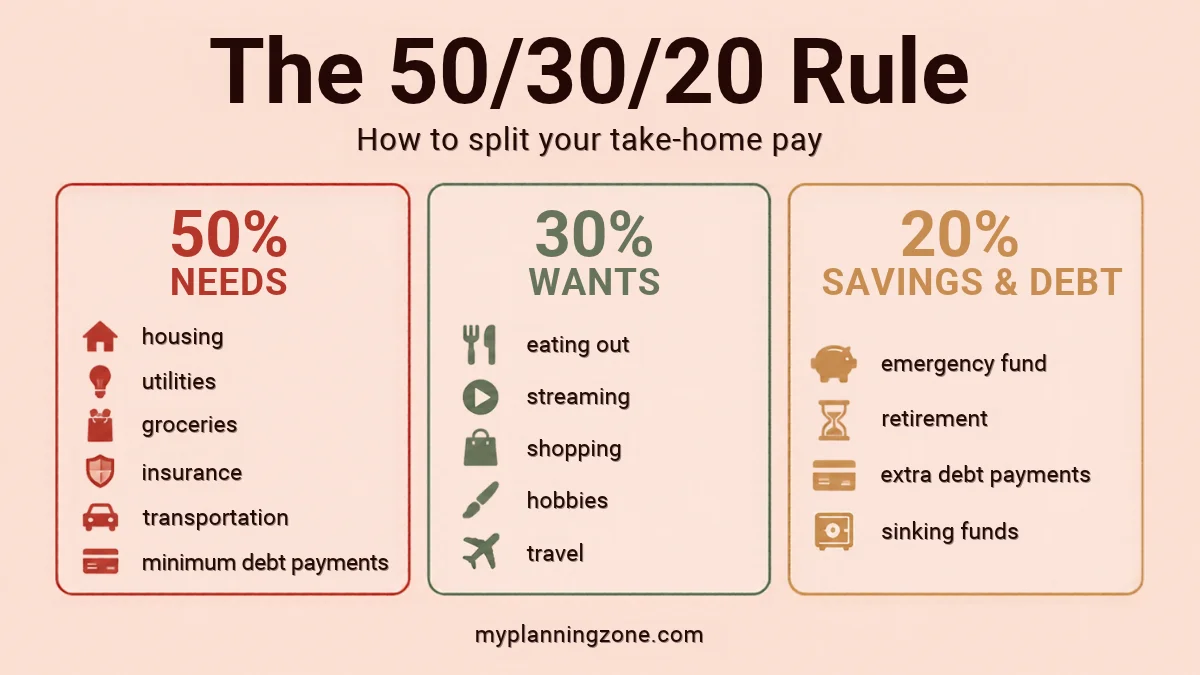
The 50/30/20 rule is a simple budgeting method that divides your after-tax income into three parts:
- 50% for needs: the bills you have to pay, like housing, utilities, groceries, insurance, transportation and minimum debt payments.
- 30% for wants: the things that make life enjoyable but you could live without, like eating out, streaming, shopping, hobbies and travel.
- 20% for savings and debt: your emergency fund, retirement, other savings goals and any debt payments above the minimum.
The rule was popularized by Elizabeth Warren and her daughter Amelia Warren Tyagi in their 2005 book All Your Worth: The Ultimate Lifetime Money Plan. It has stayed popular for two decades for one reason: it’s easy to remember and easy to start.
How to use the 50/30/20 rule in 4 steps
Step 1: Find your monthly take-home pay
The 50/30/20 rule uses your after-tax income, the money that actually lands in your bank account. Look at your last few pay stubs or bank deposits and add up a typical month. Include every source of income, such as a second job or side work.
- Paid every two weeks? Multiply one paycheck by 26 and divide by 12 to get an accurate monthly figure.
- Retirement or health insurance taken out of your paycheck? Many people add their pre-tax retirement contributions back into their income and count them toward the 20%. Either way works; just be consistent.
- In the UK? Use your take-home pay after income tax and National Insurance.
Step 2: Do the math
Multiply your take-home pay by 0.5, 0.3 and 0.2. For a take-home pay of $3,500 a month, that’s $1,750 for needs, $1,050 for wants and $700 for savings and debt.
Step 3: Sort your current spending into the three buckets
Go through last month’s bank and card statements and label each expense as a need, a want or savings. Our guide to tracking your expenses shows a few easy ways to do this. Then total each bucket.
Step 4: Compare and adjust
Compare what you actually spend with your 50/30/20 targets. Most people find their wants are higher than they thought and their savings lower. Start by moving money from wants to savings, a little at a time. If your needs are over 50%, see the alternatives later in this guide.
50/30/20 rule examples by income
Here’s how the split looks at different monthly take-home incomes:
| Monthly take-home pay | Needs (50%) | Wants (30%) | Savings & debt (20%) |
|---|---|---|---|
| $2,500 | $1,250 | $750 | $500 |
| $3,500 | $1,750 | $1,050 | $700 |
| $5,000 | $2,500 | $1,500 | $1,000 |
| $6,500 | $3,250 | $1,950 | $1,300 |
| $8,000 | $4,000 | $2,400 | $1,600 |
The percentages stay the same at every income level, which is what makes the rule easy to use. What changes is how comfortable each bucket feels. At lower incomes, 50% often isn’t enough to cover needs. At higher incomes, you may be able to save much more than 20%.
Want to see a full example with every line filled in? Our guide on how to make a budget includes a complete $4,000 monthly budget using the 50/30/20 rule.
Needs vs. wants: what goes where
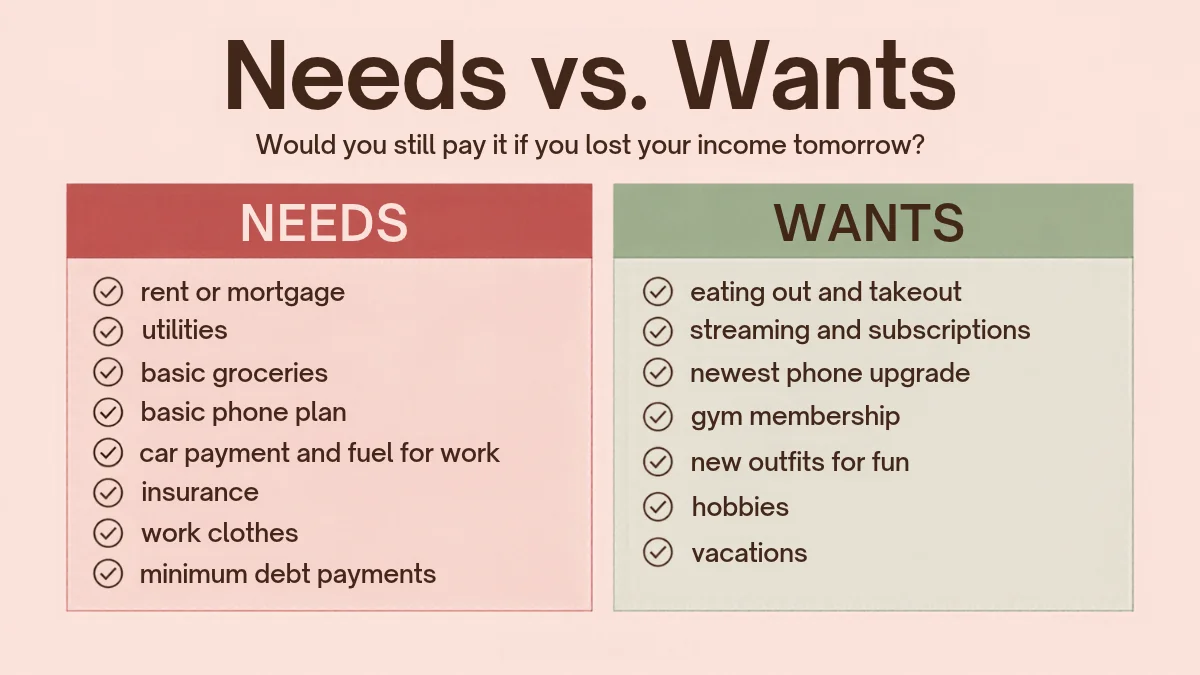
The hardest part of the 50/30/20 rule is being honest about needs and wants. A simple test: would you still have to pay it if you lost your income tomorrow? If yes, it’s a need. If you’d cancel it, it’s a want.
Some expenses sit in a gray area. Here’s how to handle the most common ones:
- Groceries vs. eating out: basic groceries are a need. Restaurants, takeout and coffee shops are wants.
- Your phone and internet: a basic plan is a need. The upgrade to the newest phone or the fastest plan is a want.
- Your car: getting to work is a need, so a reasonable car payment, insurance and fuel count. A luxury model’s extra cost is closer to a want.
- Clothing: work clothes and replacing worn-out basics are needs. New outfits for fun are wants.
- Debt payments: the minimum payment is a need. Anything extra you pay to clear debt faster goes in the 20% bucket.
- Gym and subscriptions: almost always wants, even the ones you use.
What counts toward the 20%?
The 20% bucket is for your future self. If you’re not sure where to start, fill it in this order:
- A starter emergency fund, so a car repair doesn’t land on a credit card. Our guide on how to save for an emergency fund walks you through it.
- Extra payments on high-interest debt, like credit cards.
- Retirement savings, especially if your employer matches contributions.
- Sinking funds for big planned costs like holidays, a vacation or a new car.
A fun way to fill your savings bucket is a savings challenge. Our 2027 savings challenge breaks the year into small weekly amounts.
Does the 50/30/20 rule still work?
For many households, yes, as a target to work toward. But housing is expensive. According to the U.S. Bureau of Labor Statistics, the average household spent $27,790 on housing in 2025, or 33.9% of total spending. Add transportation and food, and needs can easily pass 50%, especially in high-cost cities.
The 50/30/20 rule may not fit you right now if:
- You live in a high-cost area where rent alone takes 40% of your income or more.
- Your income is low or just starting out, so needs take most of it.
- You have a lot of high-interest debt and want to pay it off faster than 20% allows.
- Your income is irregular and changes a lot from month to month.
That doesn’t mean budgeting won’t work for you. It means you need different percentages.
Alternatives to the 50/30/20 rule
Use the split that matches your situation today, and move toward 50/30/20 as things improve.
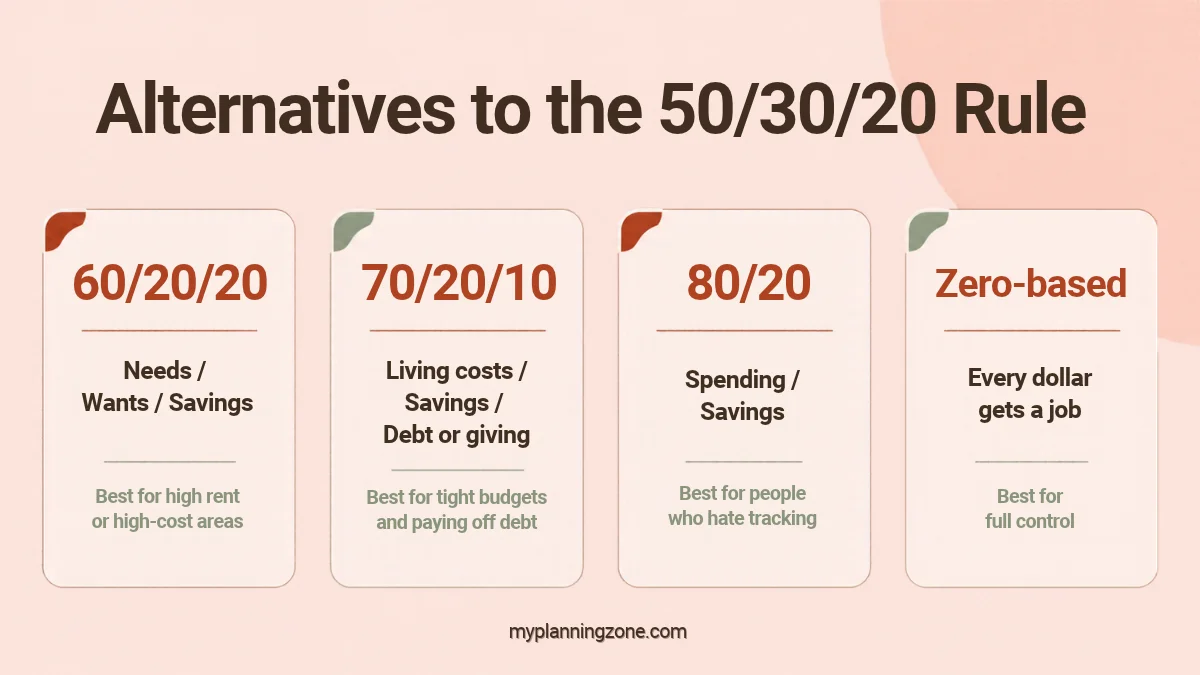
- 60/20/20: for high rent or high-cost areas. Needs get more room, wants get less, and savings stay at 20%.
- 70/20/10: for tight budgets or paying off debt. 70% to needs and wants combined, 20% to savings, 10% to debt or giving.
- 80/20: the simplest version. Save 20% first, then spend the other 80% however you like without tracking categories.
- Zero-based budget: for full control. Every dollar gets a specific job until income minus spending equals zero. Our budgeting guide compares it with other methods.
Tips to make the 50/30/20 rule stick
- Use separate accounts. Have your paycheck split automatically: bills from one account, fun money from another, and savings moved out on payday.
- Automate the 20%. Savings you never see are savings you don’t spend.
- Check your buckets weekly. Ten minutes on a Sunday is enough. Our weekly planning routine makes it a habit.
- Recalculate when your income changes, after a raise, a new job or a move.
- Don’t aim for perfect. Being at 55/25/20 is a win. The goal is balance, not exact percentages.
If you like planning on paper, our Paycheck Budget Planner gives you printable pages to split each paycheck into bills, spending and savings, so your 50/30/20 plan is in one place.
Frequently asked questions
Is the 50/30/20 rule based on gross or net income?
The 50/30/20 rule uses net income: your take-home pay after taxes. If retirement contributions or health insurance are taken out of your paycheck, you can add pre-tax retirement savings back in and count them toward the 20% savings bucket.
Do debt payments go in needs or savings?
Minimum payments on loans and credit cards count as needs, because you have to pay them. Any extra payment above the minimum goes in the 20% savings and debt bucket.
What if my needs are more than 50% of my income?
Start by cutting wants so savings can stay as close to 20% as possible. Then look at your biggest needs, like housing and transportation, for longer-term savings. In the meantime, a 60/20/20 or 70/20/10 split is a realistic alternative.
Is rent a need or a want?
Rent or a mortgage payment is a need. If you live somewhere much more expensive than you need, part of that cost is really a want, but most people simply count all of their housing as a need.
Who created the 50/30/20 rule?
The 50/30/20 rule was popularized by Elizabeth Warren and Amelia Warren Tyagi in their 2005 book All Your Worth: The Ultimate Lifetime Money Plan.
Is the 50/30/20 rule good for beginners?
Yes. It’s one of the easiest ways to start budgeting because you only track three categories. Once you’re comfortable, you can switch to a more detailed method like a zero-based budget if you want more control.
Try the 50/30/20 rule this month
Take your monthly take-home pay, multiply it by 0.5, 0.3 and 0.2, and write the three numbers down. Then sort last month’s spending into needs, wants and savings and see how close you are. Even if your first split is far from 50/30/20, you now know exactly where to start.