
Car insurance renews, the kids need new shoes, Christmas comes around again, and suddenly a “good” month turns into a stressful one. None of these costs is a surprise. They just don’t arrive every month, so most budgets forget about them.
Sinking funds fix that. You save a small amount every month for each big expense you know is coming, so the money is already there when the bill arrives. This guide explains what sinking funds are, how they differ from an emergency fund, how to set them up in 5 steps, and gives you 26 sinking fund categories to choose from.
In this guide
What is a sinking fund?
A sinking fund is money you set aside a little at a time for a specific, planned expense. Each fund has a goal amount, a due date and a monthly amount.
Example: your car insurance costs $600 and renews in six months. Instead of finding $600 at once, you save $100 a month for six months. When the bill arrives, you pay it from the sinking fund and your monthly budget doesn’t change.
The name comes from finance, where companies set money aside to pay off a debt over time. In personal budgeting, it simply means saving ahead for the costs you can see coming.
Sinking fund vs. emergency fund
Both are savings, but they do different jobs:
| Sinking fund | Emergency fund | |
|---|---|---|
| What it’s for | Planned expenses you know are coming | Unexpected events like job loss or a big repair |
| Amount | A set goal for each expense | Usually 3 to 6 months of essential expenses |
| Timing | You know roughly when you’ll spend it | You hope you never need it |
| How many | Several, one per expense | One |
| Example | $75 a month for Christmas | Covering bills if you lose your job |
You need both. An emergency fund protects you from surprises, and sinking funds stop planned costs from eating into it. It matters: in the Federal Reserve’s latest household survey, 63% of adults said they would cover a $400 emergency expense with cash or its equivalent, so more than a third would need to pay some other way, such as carrying a credit card balance or borrowing, and 12% said they couldn’t pay it at all. Our guide on how to save for an emergency fund covers the other half.
How to set up sinking funds in 5 steps
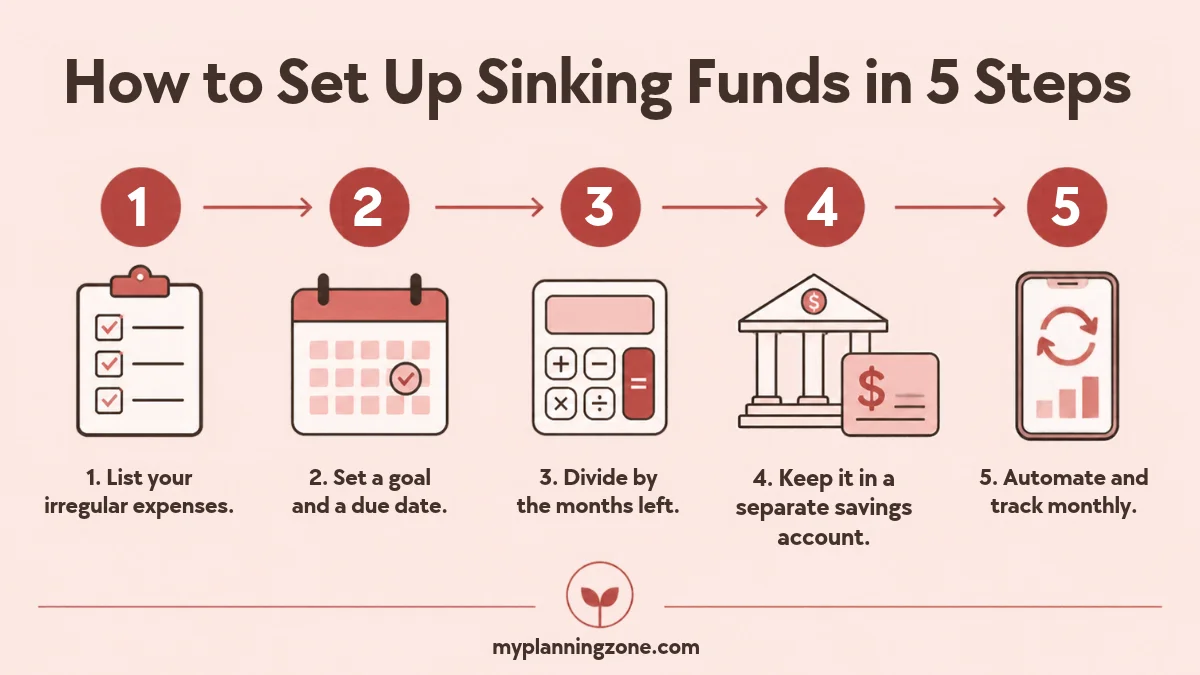
Step 1: List your irregular expenses
Go through the last 12 months of bank and card statements and write down every cost that didn’t happen monthly: insurance, car repairs, gifts, school costs, vet bills, annual subscriptions, holidays. Our guide to tracking your expenses makes this faster.
Step 2: Set a goal amount and a due date
For each expense, write how much you’ll need and when. Use last year’s amount as a starting point and round up a little for price increases.
Step 3: Work out the monthly amount
Divide the goal by the number of months until the due date. A $900 Christmas fund with 12 months to go needs $75 a month. If the date is closer, the monthly amount is higher, so start with the expenses that are coming up first.
Step 4: Decide where to keep the money
Keep sinking funds out of your checking account so you don’t spend them by accident. The easiest option is a high-yield savings account; many banks let you open several sub-accounts or “buckets” and name each one. You can also keep one savings account and track each fund on paper or in a spreadsheet, or use cash envelopes for small funds.
Step 5: Automate it and track your balances
Set up an automatic transfer on payday for the total monthly amount. Once a month, update the balance of each fund so you always know how much is set aside for what.
26 sinking fund categories
You don’t need all of these. Pick the 3 to 5 that cause the most stress in your budget and start there.
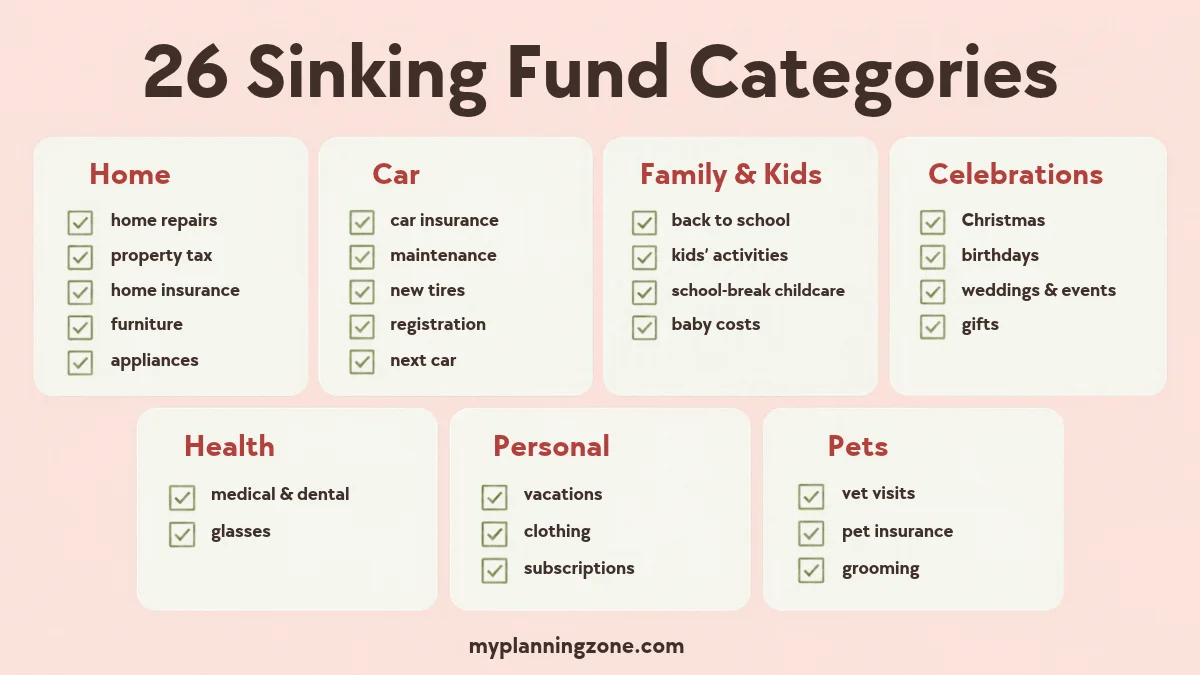
- Home: home repairs, property tax, home or renter’s insurance, new furniture, appliance replacement.
- Car: car insurance, maintenance and repairs, new tires, registration, your next car.
- Family and kids: back-to-school costs, kids’ activities and sports, childcare during school breaks, baby costs.
- Celebrations: Christmas and holidays, birthdays, weddings and other events, gifts for teachers and friends.
- Health: medical and dental bills, glasses or contact lenses.
- Personal: vacations, clothing, annual subscriptions and memberships.
- Pets: vet visits, pet insurance, grooming.
Christmas is the sinking fund most people wish they had started. Our Christmas budget guide shows how to set your holiday total, and that number divided by 12 is your monthly Christmas fund.
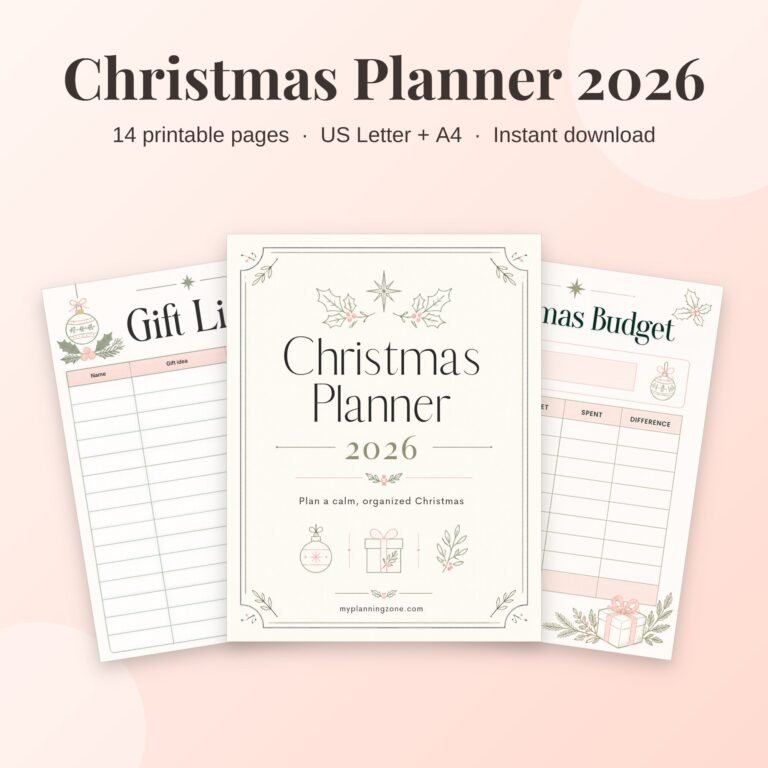
PRINTABLE PLANNER
Keep your Christmas budget on paper
Black Friday: $2.99 (was $3.99), Fri 27 to Mon 30 Nov
The Christmas Planner 2026 has a budget page with planned vs. spent by category, a gift list with a budget per person, plus a menu, grocery list and week-by-week to-do list. 14 pages, US Letter + A4, instant download.
Get the plannerExample: a yearly sinking funds plan
Here’s what six common sinking funds could look like for one household:
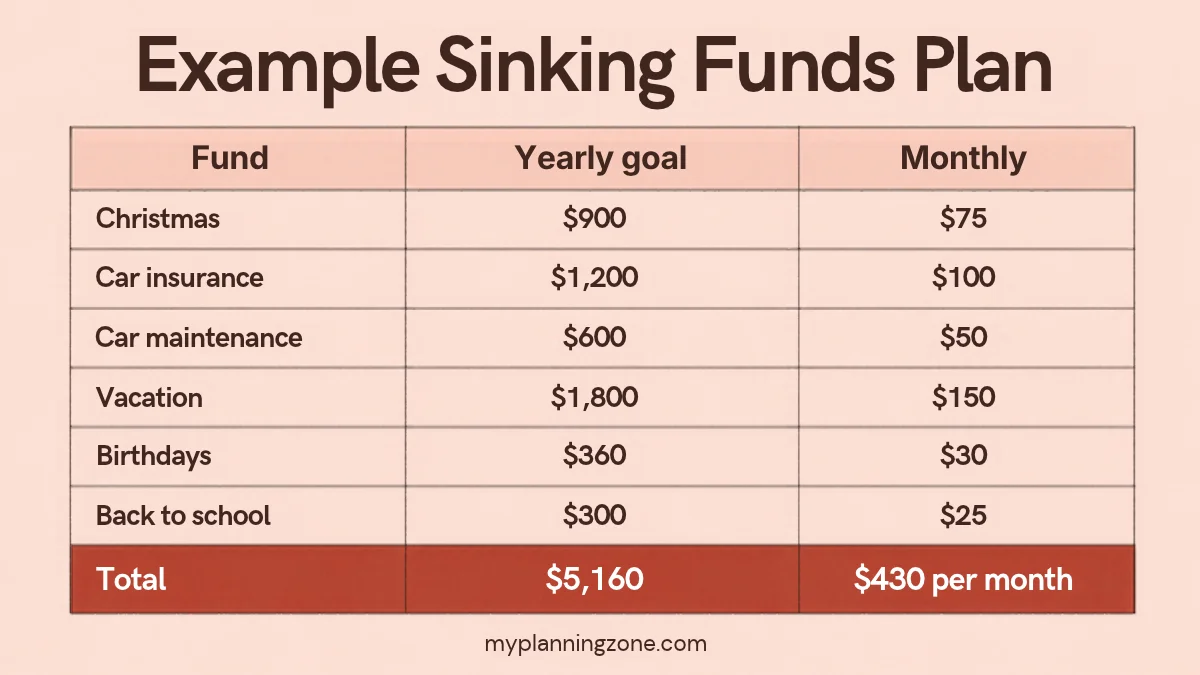
- Christmas: $900 a year = $75 a month
- Car insurance: $1,200 a year = $100 a month
- Car maintenance: $600 a year = $50 a month
- Vacation: $1,800 a year = $150 a month
- Birthdays: $360 a year = $30 a month
- Back to school: $300 a year = $25 a month
That’s $430 a month in total. It sounds like a lot, but these costs were already in this household’s year. Before sinking funds, they landed as $1,200 or $900 surprises; now they’re small, planned monthly amounts.
Where sinking funds fit in your budget
Sinking funds are a line in your monthly budget, just like rent or groceries. If you use the 50/30/20 rule, most people count them in the 20% savings bucket. If you’re new to budgeting, our guide on how to make a budget shows how to plan for yearly expenses from the start.
If your budget feels too tight for $430, start smaller. Even $20 a month toward Christmas and $25 toward car repairs is a big improvement on $0.
Common sinking fund mistakes
- Starting too many funds at once. Ten funds of $10 each are hard to track. Start with the three biggest.
- Keeping the money in checking. If you can see it, you’ll spend it.
- Using sinking funds for emergencies. If you raid the vacation fund for a car repair, you’ll be short again later. That’s what the emergency fund is for.
- Not updating the amounts. Review your funds every January, when insurance and other prices often change.
- Forgetting to spend them. When the bill arrives, use the fund. That’s the whole point.
If you like planning on paper, our Paycheck Budget Planner helps you set aside your sinking fund amounts every payday, and our Printable Money Saving Challenge turns saving for a goal into something you can tick off.
Frequently asked questions
What are sinking funds?
Sinking funds are money you set aside a little at a time for a specific, planned expense, like Christmas, car insurance or a vacation. Each fund has a goal amount and a due date, so the money is ready when the bill arrives.
What is the difference between a sinking fund and an emergency fund?
A sinking fund is for expenses you know are coming, like insurance or holidays. An emergency fund is for surprises, like losing your job or an unexpected repair. Most people need both.
How many sinking funds should I have?
Start with three to five for your biggest irregular expenses, such as Christmas, car costs and insurance. You can add more once saving for those becomes automatic.
Where should I keep my sinking funds?
Keep them outside your checking account so you don’t spend them by accident. A high-yield savings account with separate sub-accounts or buckets is the easiest option, but one savings account plus a simple tracker also works.
How do I calculate how much to put in a sinking fund?
Divide the amount you’ll need by the number of months until you need it. For example, $600 due in six months means saving $100 a month.
Are sinking funds part of the 50/30/20 rule?
Yes. Most people count sinking funds in the 20% savings part of the 50/30/20 rule, because they’re money set aside for future expenses.
Start your first three sinking funds this month
Look at last year’s statements, pick the three irregular expenses that hurt the most, and divide each one by the months until it’s due. Set up one automatic transfer for the total on your next payday. By next December, the bills that used to cause stress will already be paid for.