

January is when most people look at their bank statement and wince. The holidays are paid for, the new year has started, and the money that should have gone to savings went on takeout, online orders and things you don’t remember buying.
A no-spend challenge is a simple reset. For a set number of days, you pay only for the essentials and skip everything else. This guide explains how it works, which rules to use, how to plan a 30-day challenge step by step, and what to do instead of spending, so you finish with more money and better habits instead of a rebound shopping spree.
In this guide
What is a no-spend challenge?
A no-spend challenge is a set period, usually a weekend, a week or a month, when you only spend money on things you truly need. Bills, rent, basic groceries, fuel and medicine are allowed. Takeout, shopping, coffee runs and impulse buys are not.
The point isn’t to spend nothing at all. It’s to break the automatic, everyday spending that quietly drains a budget, and to see how much of it you don’t miss.
Those small purchases add up. According to the U.S. Bureau of Labor Statistics Consumer Expenditure Survey, the average American household spent $4,142 on food away from home in 2025, or about $345 a month. That one category alone is where many no-spend challenges find their biggest savings.
Types of no-spend challenges
There’s no single right length. Pick the version that matches your experience and your goal:
| Type | How it works | Best for |
|---|---|---|
| No-spend weekend | No non-essential spending from Friday night to Sunday night | A first try with low pressure |
| No-spend week | 7 days of essentials only | Testing your rules before a longer challenge |
| No-spend month | 30 days of essentials only, often in January | A full reset and a real boost to savings |
| Category challenge | Cut one or two categories, like takeout or clothes, and spend normally on the rest | Fixing one problem area |
| No-spend days | Choose a number of days each month, like 10 or 15, with zero spending | Building the habit slowly |
| No-buy year | 12 months without buying new items in chosen categories | Experienced savers with a big goal |
If you’ve never tried one, start with a weekend or a week. A full month is much easier once you know where your temptations are.
No-spend challenge rules: what to buy and what to skip
Your rules decide whether the challenge works. Write them down before you start, so you aren’t deciding at the checkout.
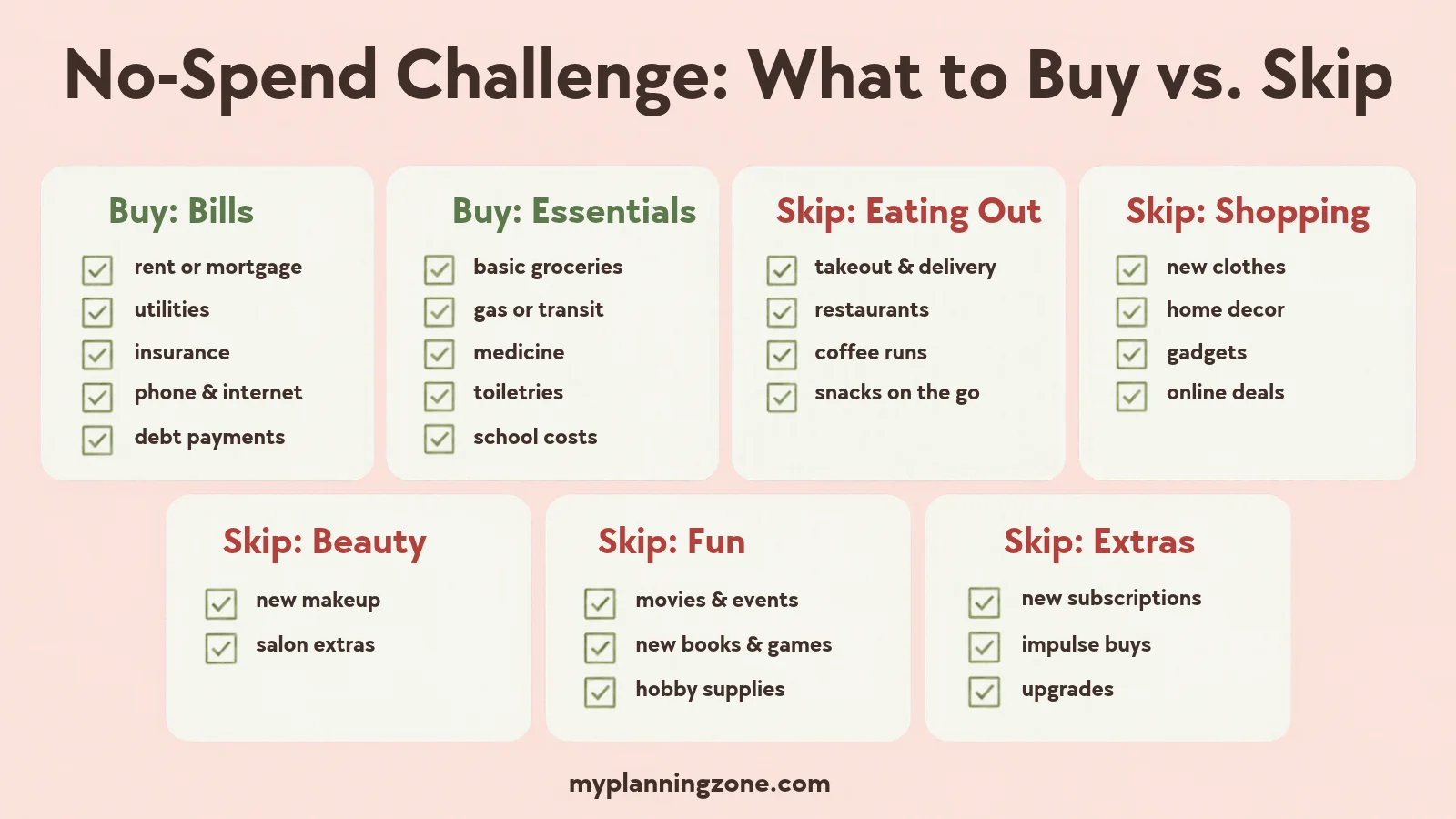
Usually allowed
- Rent or mortgage, utilities, insurance, phone and internet
- Minimum debt payments and any bills already scheduled
- Basic groceries from a planned list
- Fuel or public transport to get to work and school
- Medicine, toiletries and household basics when you run out
- Childcare and school costs
Usually off-limits
- Takeout, delivery apps, restaurants and coffee shops
- Clothes, shoes, home decor and gadgets
- Online “deals” and anything in a shopping cart you were saving for later
- New subscriptions, apps and in-game purchases
- Beauty extras, hobby supplies and new books or games
- Snacks and drinks bought on the go
Decide your exceptions in advance
Real life doesn’t pause for a challenge. Agree on these before day one:
- Planned events. A birthday gift or a friend’s wedding can stay, as long as it was on your calendar before you started.
- Replacements. If something essential breaks, like your only pair of work shoes, replace it with the cheapest option that does the job.
- Shared plans. Decide whether a monthly date night or one coffee with a friend is allowed. A small, planned treat is better than giving up halfway.
- Gift cards. Spending a gift card you already have is usually fine, because the money is already spent.
How to do a no-spend challenge in 5 steps
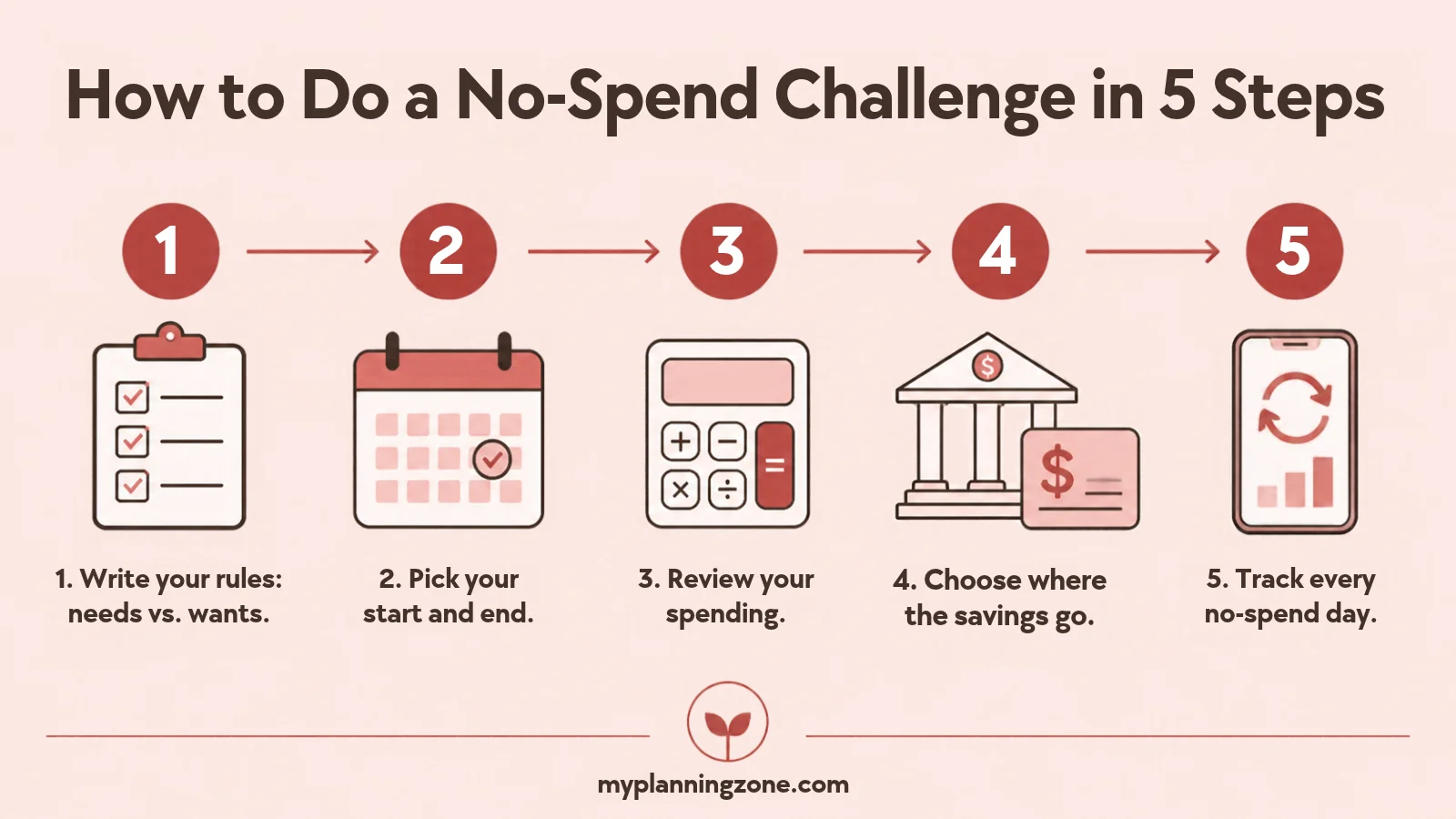
Step 1: Write your rules
List what counts as a need and what you’ll skip, plus the exceptions above. Keep it to one page. If you share a home, agree on the rules together, or the challenge will fall apart the first time someone orders pizza.
Step 2: Pick your start and end dates
Choose a length you can finish and put both dates on your calendar. Look ahead for birthdays, trips and events in that window, and decide now how you’ll handle them. January is a popular choice because spending is naturally lower after the holidays.
Step 3: Review your spending
Look at the last one or two months of bank and card statements. Circle the purchases that weren’t essential and add them up by category. This shows you where your temptations are and gives you a target to beat. Our guide to tracking your expenses walks you through it.
Step 4: Choose where the savings go
Money you don’t spend tends to disappear into the rest of the budget. Give it a job before you start: an emergency fund, a debt payment, or one of your sinking funds. Then move the amount you’d normally spend into savings at the start of each week, so it’s out of reach.
Step 5: Track every no-spend day
Mark each day you stick to the rules on a calendar or tracker. Seeing a streak build is surprisingly motivating, and writing down the days you slip shows you exactly which situations to plan for next time. A visual tracker like our Printable Money Saving Challenge works well for coloring in each day you save.
A 30-day no-spend challenge plan
A month feels long when you look at it as one block. Breaking it into four weeks, each with one focus, makes it manageable:
| Week | Focus | What to do |
|---|---|---|
| Week 1 | Prepare and use what you have | Plan meals from what’s already in your pantry and freezer. Unsubscribe from store emails and delete shopping apps from your phone. |
| Week 2 | Handle the cravings | This is when most people slip. Keep a “wish list” and write down anything you want to buy instead of buying it. |
| Week 3 | Find free fun | Plan at least two free activities for the weekend so boredom doesn’t send you shopping. |
| Week 4 | Review and plan ahead | Add up what you saved, review your wish list (most items will no longer feel urgent) and decide which habits to keep. |
Meal planning does a lot of the work in week 1. If you like planning on paper, our Printable Meal Planner keeps your weekly menu and grocery list in one place.
25 free things to do instead of spending
Most spending during a challenge isn’t about need. It’s boredom, habit or wanting a treat. Keep this list handy for those moments:
- Go for a walk or hike somewhere new
- Borrow books, movies or audiobooks from your library
- Cook a new recipe with what’s in your cupboard
- Have a potluck or game night at home
- Declutter one drawer or closet
- Sell things you no longer use
- Try a free workout video
- Visit a free museum day or local event
- Have a picnic in the park
- Start a journal
- Learn a skill with free online lessons
- Call or video chat with a friend
- Rewatch a favorite movie you already own
- Do a puzzle or play board games you already have
- Plan your next goals for the year
- Batch cook meals for the week
- Rearrange a room with furniture you have
- Swap clothes or books with friends
- Volunteer locally
- Go to a free community class or meetup
- Have a spa night with products you already own
- Bake something from pantry basics
- Take photos around your neighborhood
- Organize your digital files and photos
- Write a gratitude list or a letter to a friend
Example: what one no-spend month can save
Here’s a simple example of a household that cuts takeout, eating out, coffee runs, shopping and online impulse buys for one month. They spend a little more on groceries because they cook at home, but still keep most of the money:
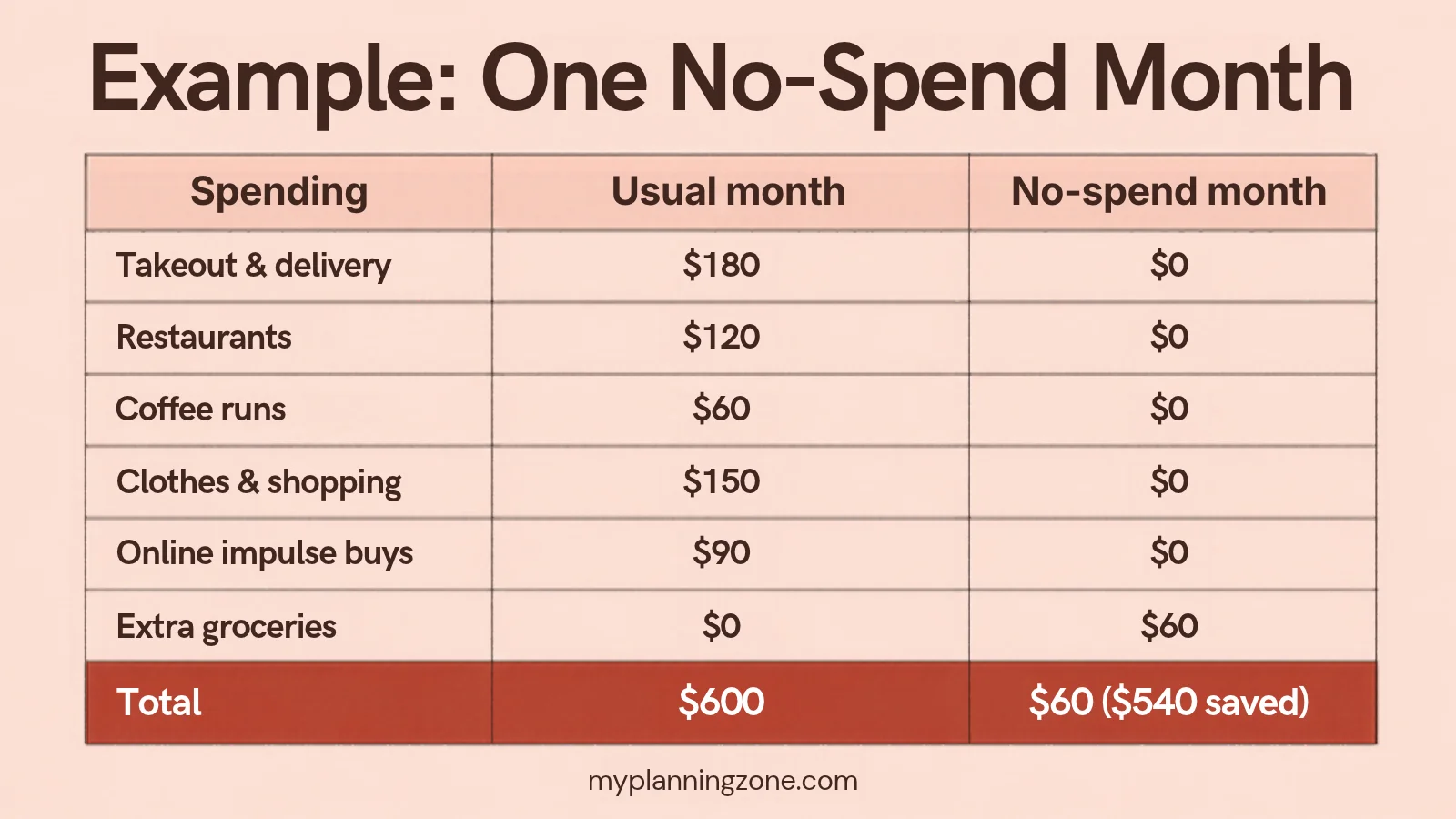
These numbers are an illustration, not an average. Use your own statements from Step 3 to work out what your challenge could save. Even half of this is a strong result for one month.
How to stay on track
- Add friction. Log out of shopping sites, remove saved cards from your browser and turn off app notifications.
- Use a 48-hour rule. If you want something, write it down and wait two days. If you still need it after the challenge, plan it into your budget.
- Shop with a list only. Go to the grocery store with a list, and avoid browsing aisles you don’t need.
- Tell someone. A friend or partner who knows about your challenge makes it easier to say no to spontaneous plans.
- Pay yourself first. Move the money you would have spent into savings at the start of each week.
What to do if you slip
One purchase doesn’t ruin the challenge. Write down what you bought and why, then start again the next day. Most slips happen in the same few situations (being tired, hungry or bored), and spotting your pattern is one of the most useful things the challenge teaches you.
After the challenge: avoid rebound spending
The biggest risk comes on day 31, when it’s tempting to “reward” yourself with everything you skipped. To keep your progress:
- Review your wish list and buy only what still matters, with a set budget.
- Keep one or two rules permanently, like no delivery apps on weekdays.
- Add a realistic “fun money” line to your budget so you never feel completely restricted.
- Schedule one no-spend week every quarter as a regular reset.
If you want a full system for the rest of the year, start with our guide on how to make a budget, then try the 50/30/20 rule to split your income between needs, wants and savings.
No-spend challenge vs. no-buy challenge
The two are similar, and people often use the names interchangeably. A no-spend challenge usually covers all non-essential spending for a short time, like a weekend or a month. A no-buy challenge usually targets buying new things, like clothes, beauty products or home decor, often for longer, such as 3 months or a full year, while experiences like meals out may still be allowed.
If your goal is to save money fast, a no-spend month works best. If your goal is to reduce clutter and overconsumption, a no-buy challenge may suit you better. For more ways to save in 2027, see our savings challenge ideas.
Frequently asked questions
What is a no-spend challenge?
A no-spend challenge is a set period, often a week or a month, when you spend money only on essentials like rent, bills, basic groceries, fuel and medicine, and skip non-essentials like takeout, shopping and entertainment.
What are the rules of a no-spend challenge?
You choose your own rules. Most people allow bills, debt payments, basic groceries, transport, medicine and toiletries, and skip eating out, shopping, new subscriptions and impulse buys. Decide your exceptions, like planned gifts, before you start.
How much can you save with a no-spend challenge?
It depends on your usual spending. Add up your non-essential purchases from last month to estimate it. For example, a household that normally spends $600 a month on takeout, coffee, shopping and online orders could save around $500 even after buying a little more food.
Can you buy groceries on a no-spend challenge?
Yes. Basic groceries are allowed in almost every no-spend challenge. Shop from a planned list, use up what you already have first, and skip snacks and treats bought on the go.
How long should a no-spend challenge last?
Beginners usually do best with a weekend or a week. Once that feels easy, try a full month. January is a popular time because spending is naturally lower after the holidays.
What is the difference between a no-spend and a no-buy challenge?
A no-spend challenge cuts all non-essential spending for a short period. A no-buy challenge usually stops buying new things in certain categories, like clothes or beauty products, often for several months or a year.
Start with a no-spend week
Write your rules on one page, pick a week on your calendar, and move the money you’d normally spend into savings on day one. When the week ends, count what you kept and decide whether you’re ready for a full month. Most people are surprised by how little they miss.