

If every cleaning schedule you’ve tried lasted about four days, the schedule was the problem, not you. Most routines assume you’ll remember the plan, feel like starting, and have energy left at the end of the day. An ADHD cleaning schedule works differently: it’s short, visible, and built so that a missed day costs you nothing.
Below you’ll find a complete weekly plan (15 minutes a day), a 10-minute daily reset, a monthly deep-clean rotation, and a “bare minimum” version for the weeks when nothing goes to plan. Copy it as-is, or adjust it to your home.
In this guide
Why regular cleaning schedules don’t work with ADHD
The National Institute of Mental Health lists difficulty organizing tasks, managing time, and being forgetful in daily activities such as chores among the common signs of ADHD. That lines up with where traditional cleaning plans break down:
- They depend on memory. A schedule saved in an app you never open is invisible, so it doesn’t exist.
- The tasks are too big. “Clean the bathroom” is a project with a dozen decisions in it. Starting feels heavy, so you don’t.
- They’re all-or-nothing. Miss Tuesday and the plan feels broken, so you abandon it.
- They ignore energy. The same task can feel easy on Monday morning and impossible on Thursday night.
A schedule that works with ADHD fixes those four things. It lives somewhere you’ll see it, it breaks work into small specific actions, it has a time limit instead of a finish line, and it expects missed days.
The 4 rules of an ADHD-friendly cleaning schedule
1. Use a timer, not a to-do list
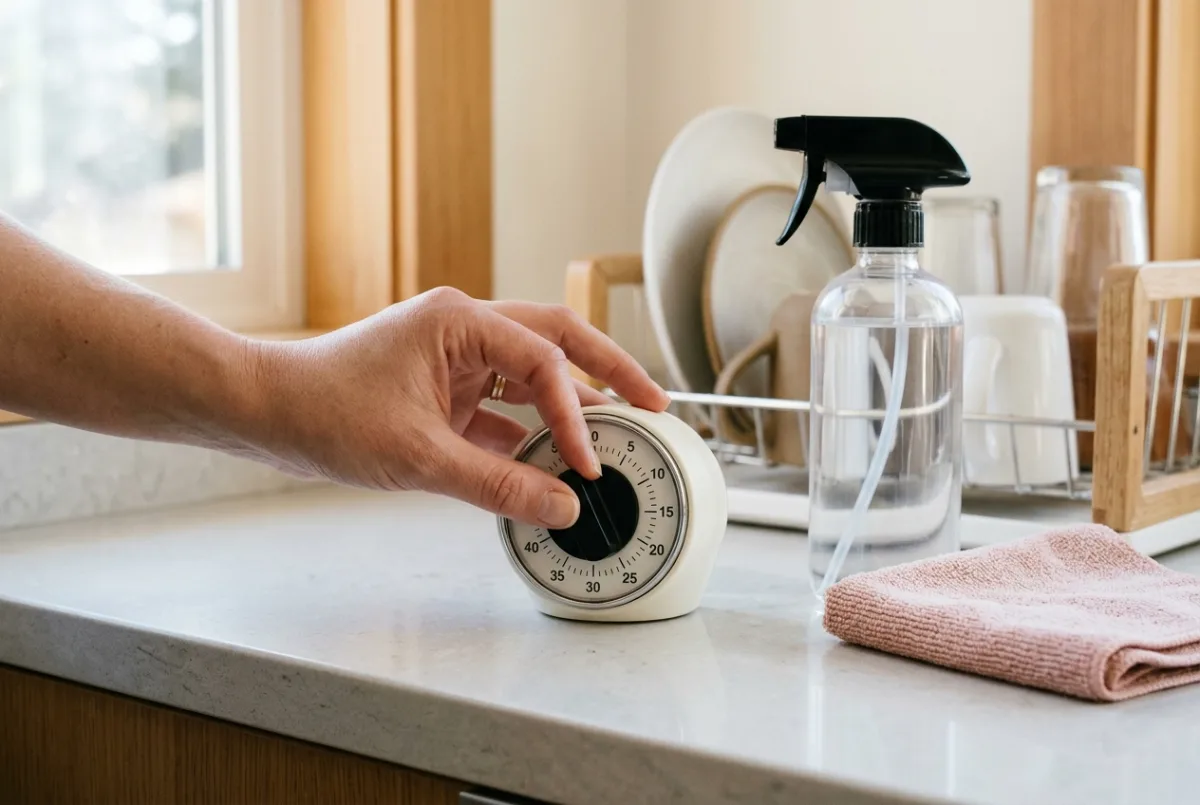
Set a timer for 15 minutes and stop when it rings, even mid-task. A clear end point makes starting easier, and stopping on time keeps cleaning from turning into a three-hour spiral you’ll avoid next week. If timed sprints already help you at work, this is the same idea as the Pomodoro Technique, applied to your home.
2. One zone per day
Giving each day a single focus area removes the “where do I even start?” decision. You don’t have to think about the whole house on Monday. Just the kitchen.
3. Make it visible
Print the schedule and put it where the work happens: on the fridge, inside a cabinet door, or next to the bathroom mirror. Checking boxes on paper also gives you a quick, visible win.
4. Plan for missed days
Saturday in the plan below is a catch-up day, and there’s a low-energy version for rough weeks. Missing a day is part of the system, not a failure of it.
The 10-minute daily reset
These three tasks stop the house from sliding backwards. Do them once a day, ideally attached to something you already do, like right after dinner or while the kettle boils.
- Dishes (about 5 minutes): load or unload the dishwasher, or wash what’s in the sink.
- Wipe the kitchen counters (about 2 minutes): just the counters, not the whole kitchen.
- One basket of clutter (about 3 minutes): walk through the main living area with a basket, collect whatever is out of place, and put it away. If something doesn’t have a home, leave it in the basket. That’s a decluttering job for another day.
Any task that takes less than two minutes, like hanging up a coat or throwing away mail, you can do the moment you notice it. That’s the 2-Minute Rule, and it keeps small messes from piling up between resets.
The weekly ADHD cleaning schedule (15 minutes a day)
Here’s the full week. Each day has one zone and a short list of tasks in priority order. Start at the top and do as much as fits in 15 minutes. Whatever’s left waits until next week.
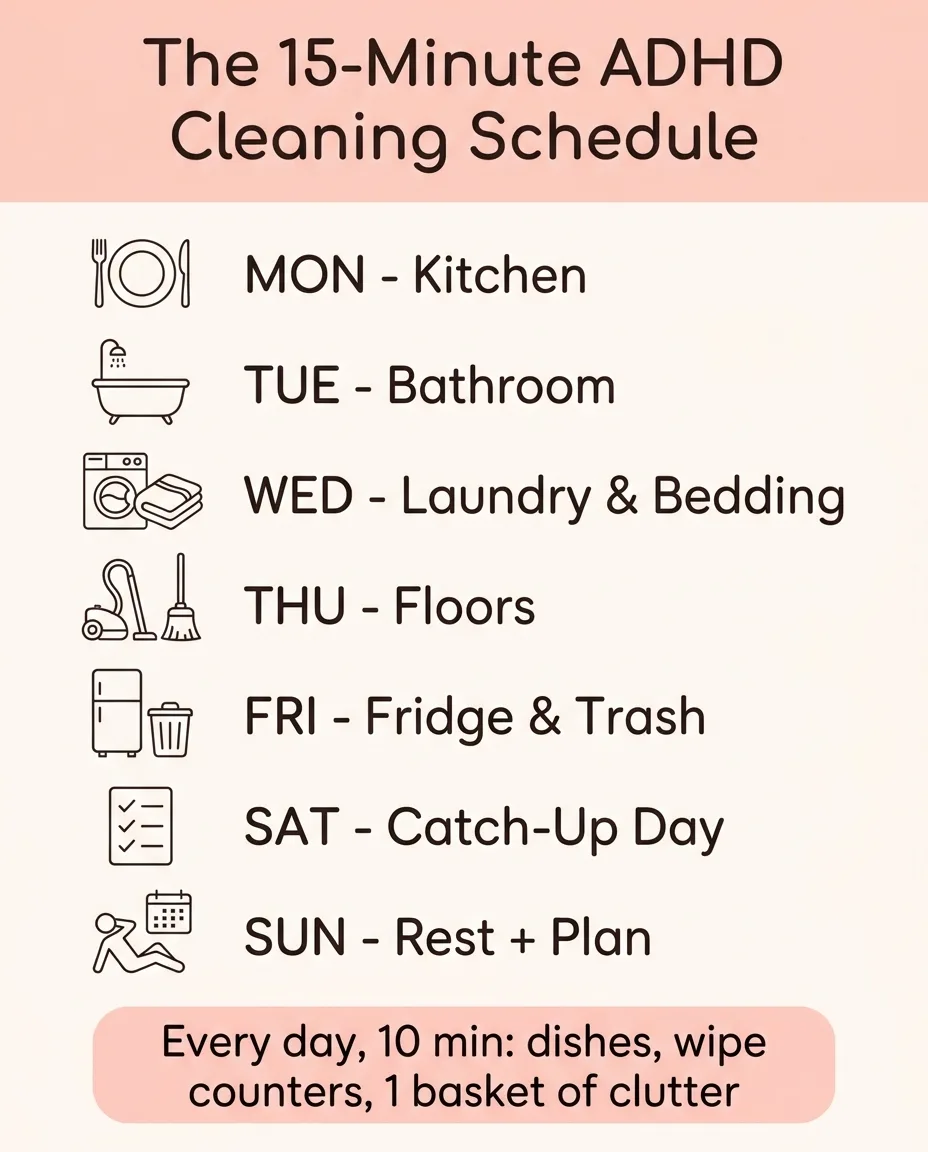
| Day | Zone | Tasks (in priority order) |
|---|---|---|
| Monday | Kitchen | Clear and wipe the stovetop · wipe appliance fronts and the microwave inside · clean the sink · sweep the kitchen floor |
| Tuesday | Bathroom | Clean the toilet · wipe the sink and mirror · swap the hand towel · quick wipe of the shower or tub walls |
| Wednesday | Laundry & bedding | Strip and change the sheets · start the wash · fold and put away one load |
| Thursday | Floors | Vacuum high-traffic areas (entryway, living room, hallway) · mop the kitchen or bathroom if time allows |
| Friday | Fridge & trash | Toss expired food · wipe one fridge shelf · empty all bins · take out trash and recycling |
| Saturday | Catch-up day | Pick the zone you skipped this week, or one monthly task (below). If you’re up to date, take it off. |
| Sunday | Rest + plan | No cleaning. Spend 5 minutes looking at the week ahead and decide which day might need the low-energy version. |
Tip: Match zones to your real week. If trash pickup is Tuesday, move “Fridge & trash” to Monday night. If you work late on Thursdays, swap Floors with a lighter day. The structure matters more than which day gets which zone. For a wider weekly planning routine, see how to plan your week.
Want this schedule ready to print?
The ADHD Cleaning Planner Bundle includes daily, weekly and monthly cleaning pages, room-by-room checklists and 30-day challenges, in printable and Canva-editable versions. Just need the basics? Start with the Printable ADHD Cleaning Checklist.
Monthly deep-clean rotation (one task per week)
Deep cleaning is where most plans fall apart, because it’s usually saved for one exhausting weekend. Instead, use your Saturday catch-up slot for one bigger task each week:
| Week | Deep-clean task |
|---|---|
| Week 1 | Empty and wipe the whole fridge |
| Week 2 | Dust high spots: ceiling fans, shelves, tops of door frames |
| Week 3 | Clean the oven and microwave |
| Week 4 | Declutter one drawer, shelf or closet section |
If you’ve got a lot of clutter to work through, Week 4 can take longer than 15 minutes. Our step-by-step decluttering guide and the room-by-room Declutter Checklist break it into smaller pieces.
The low-energy version (for bad weeks)
Some weeks the full plan isn’t realistic. That’s fine. On those days, drop to the bare minimum: the things that keep your home safe, sanitary and usable.
- Run or empty the dishwasher, or wash only what you need for the next meal
- Throw away food waste and take out the kitchen trash when it’s full
- Put dirty clothes in the hamper
- Skip the zone entirely
That’s it. When your energy comes back, restart on the next day’s zone. Don’t try to make up every skipped day. Saturday’s catch-up slot exists for exactly this.
7 tricks that make cleaning with ADHD easier
- Keep supplies where you use them. A spare spray and cloth under each bathroom sink means no hunting before you start.
- Start with the easiest visible task. One quick win builds momentum for the next.
- Pair cleaning with something you enjoy. Save a podcast, playlist or audiobook just for your 15 minutes.
- Try body doubling. Clean while a friend tidies on a video call, or while someone else is home doing their own task.
- Use open bins instead of closed storage. If you can see where something goes, you’re more likely to put it there.
- Write tasks as actions. “Wipe the bathroom mirror” is easier to start than “clean the bathroom.”
- Celebrate checked boxes. A paper checklist turns invisible effort into visible progress.
Sharing the schedule with family
In a shared home, the weekly zones are easy to split. Assign each person a day or a zone, and put names next to tasks on the printed schedule so nobody has to ask who’s doing what. Kids can take on part of the daily reset, like the clutter basket. For age-appropriate jobs, see our family chore chart guide or the printable Family Chore Chart.
Frequently asked questions
How long should I clean each day if I have ADHD?
Start with about 10 minutes for the daily reset and 15 minutes for the day’s zone. Short, fixed sessions are easier to start and easier to repeat than long ones. You can increase the time later, but consistency matters more than length.
What should I do if I fall behind on my cleaning schedule?
Restart with today’s zone instead of trying to catch up on everything. Use the low-energy version until you’re back on track, and let Saturday’s catch-up slot handle the one zone that matters most.
Is a daily or weekly cleaning schedule better for ADHD?
A combination usually works best: a tiny daily reset that keeps clutter from building, plus one zone per day across the week. Daily-only plans tend to get repetitive, and weekly-only plans often leave too much for one session.
Should I use a paper or digital ADHD cleaning planner?
Whichever you’ll actually see. Many people find a printed schedule on the fridge harder to ignore than an app notification. If you prefer digital, set recurring reminders for the exact zone, not a generic “clean” alert.
Your next step
Don’t try to start your whole ADHD cleaning schedule at once. Tonight, do the 10-minute reset. Tomorrow, add that day’s zone. By the end of the week you’ll have run the full schedule once, and you’ll know which days need adjusting.
If you’d like the whole plan on paper, with room checklists and monthly pages, grab the ADHD Cleaning Planner Bundle. And if your weekends are where routines fall apart, these productive things to do on Sundays pair well with the rest-and-plan day.
Keep reading: deep cleaning checklist (room by room) and family chore chart.
This article shares organizing strategies and isn’t medical advice. For more on ADHD itself, see the NIMH ADHD overview or the Attention Deficit Disorder Association.