

December has a way of turning “a few gifts” into a credit card bill that lasts until spring. A Christmas budget fixes that before it starts: you decide one total you can afford, split it across everything the season costs, and track it as you go.
This guide walks you through it step by step, with an example budget you can copy, a simple formula for how much to spend per person, and a 6-week plan if you’re starting in mid-November.
In this guide
Why a Christmas budget matters
Holiday spending adds up faster than most people expect. In a LendingTree survey after the 2025 holidays, 37% of Americans said they took on holiday debt, averaging $1,223. Of those, 41% were still paying off the previous year’s holidays, and 63% expected it to take three months or longer to clear the new balance.
Prices aren’t standing still either. The National Retail Federation forecasts US holiday retail sales will grow 4.2% in 2026, partly because of higher prices. A budget won’t make things cheaper, but it means you choose where the money goes instead of finding out in January.

How to make a Christmas budget in 6 steps
1. Start with what you can actually afford
Your total should come from your finances, not from what you spent last year or what you’d like to spend. Add up three things:
- Money already saved for the holidays.
- What you can set aside from each paycheck between now and Christmas, after rent, bills, groceries and debt payments.
- Any extra income you’re confident about, like a holiday bonus that’s already confirmed.
That sum is your Christmas budget. If you plan your money paycheck by paycheck, our guide on how to plan your paycheck shows how to find that spare amount without shortchanging your bills.
2. List every holiday expense, not just gifts
Gifts are the obvious cost, but budgets usually break on everything around them. Include:
- Gifts for family, friends, coworkers and teachers
- Food: the Christmas meal, baking, party contributions
- Decorations and the tree
- Travel: gas, flights, parking, pet sitting
- Events and outfits: work parties, school events, new clothes
- Wrapping, cards, postage and shipping
- Tips and donations for service workers and charities
3. Split your total into categories
Give every category a dollar amount before you shop. Here’s an example of how an $800 Christmas budget could be divided. Your split will look different, so treat this as a starting point, not a rule.
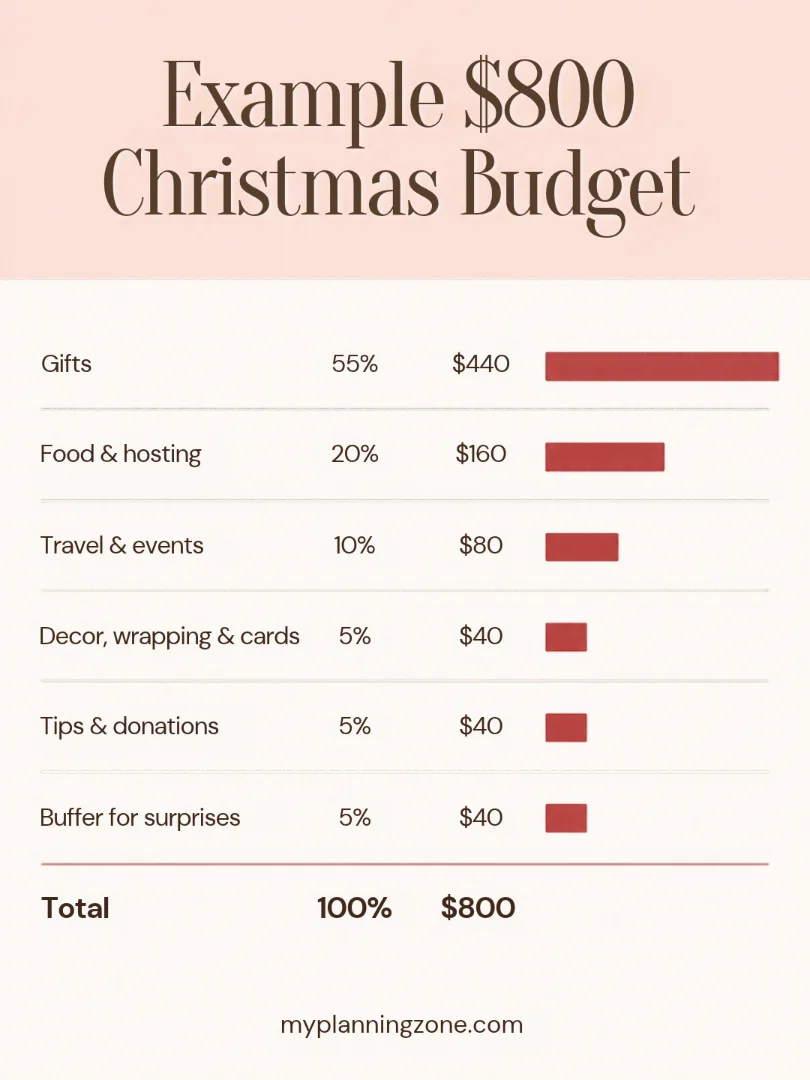
| Category | Share | Amount (of $800) |
|---|---|---|
| Gifts | 55% | $440 |
| Food and hosting | 20% | $160 |
| Travel and events | 10% | $80 |
| Decorations, wrapping and cards | 5% | $40 |
| Tips and donations | 5% | $40 |
| Buffer for surprises | 5% | $40 |
| Total | 100% | $800 |
Don’t skip the buffer. It covers the forgotten gift, the extra grocery run, and the shipping fee you didn’t plan for, so they don’t push you over your total.
4. Set a gift budget per person
Write down everyone you’re buying for, then group them into tiers. A simple formula keeps it fair and stops the first few purchases from eating the whole gift budget:
- Tier 1 (partner, kids): the largest amounts.
- Tier 2 (parents, siblings, close friends): a moderate amount each.
- Tier 3 (coworkers, teachers, neighbors): a small, fixed amount, or a group gift.
For example, with $440 for gifts: 2 Tier 1 people at $100 each, 4 Tier 2 people at $40 each, and 5 Tier 3 people at $16 each adds up to exactly $440. If your list doesn’t fit, shrink Tier 3 first: a homemade treat, a Secret Santa, or a card often means just as much.
5. Decide how you’ll pay
Paying with cash or a debit card makes it harder to overspend, because the money is either there or it isn’t. If you use a credit card for rewards or purchase protection, the Consumer Financial Protection Bureau recommends having a specific plan to pay the bill, with the money already set aside in your budget. Be just as careful with “buy now, pay later”: the payments land in January and February, on top of your regular bills.
6. Track every purchase as you go
A budget only works if you know where you stand. After each purchase, write down what you bought, who it’s for and what it cost, and subtract it from that category. A notes app, a spreadsheet or a printed page all work. Pick the one you’ll actually open. For more options, see 5 ways to track your expenses.
Plan your Christmas money on paper
The Paycheck Budget Planner helps you find how much each paycheck can put toward Christmas without missing a bill. Want to be ready earlier next year? The Printable Money Saving Challenge turns saving into small weekly steps.
Starting late? A 6-week Christmas budget plan
If you’re starting in mid-November, you have about six weeks until Christmas. That’s enough time to plan properly if you break it into one job per week.
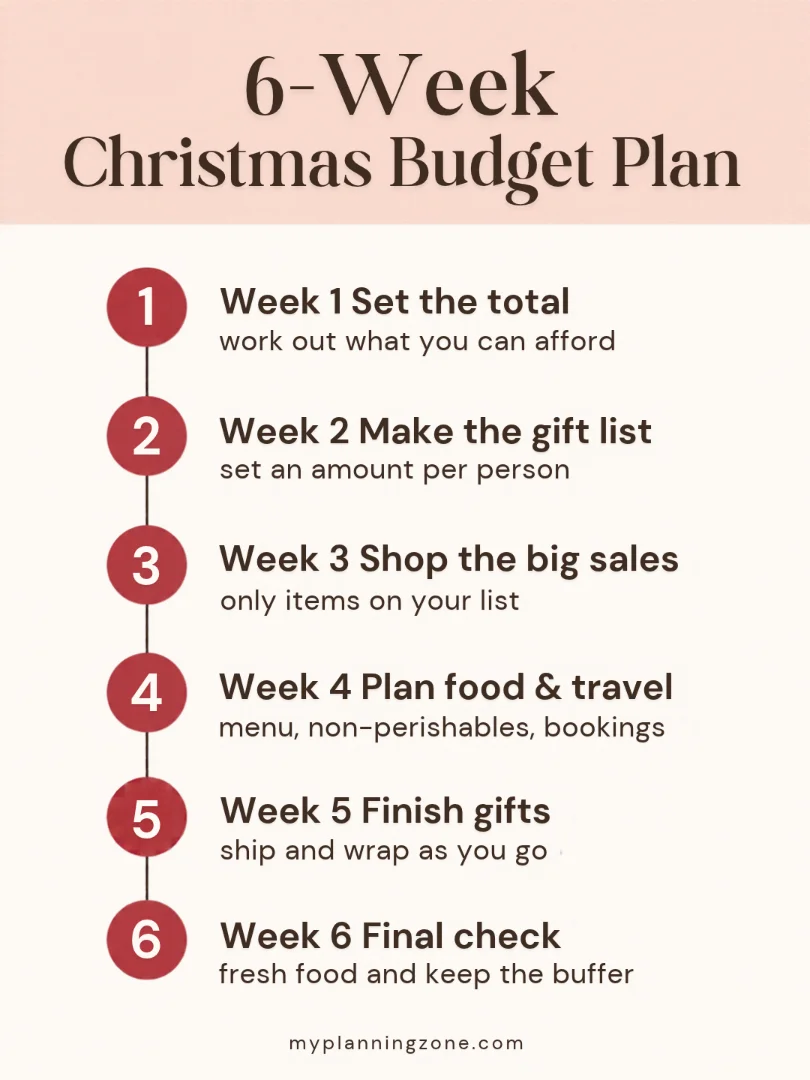
| Week | Focus | What to do |
|---|---|---|
| Week 1 | Set the total | Work out what you can afford (step 1), list every expense and split your budget into categories. |
| Week 2 | Gift list | Write your gift list with a dollar amount per person. Check what you already own: gift cards, unused presents, things to regift. |
| Week 3 | Big sales | Shop Black Friday and Cyber Monday only for items already on your list, at or below the amount you set. |
| Week 4 | Food and travel | Plan the Christmas menu, buy non-perishables, and book or price any travel. |
| Week 5 | Wrap up gifts | Finish gift shopping, mail anything that needs shipping, and wrap as you go. |
| Week 6 | Final check | Buy fresh food, review what’s left in each category, and keep the buffer for last-minute surprises. |
Sales are only savings if the item was already on your list. A discounted gift you didn’t plan to buy is still spending.
For everything beyond money, from cards and decorations to Christmas Eve prep, follow our week-by-week Christmas to-do list.
How to have Christmas on a budget (without it feeling cheap)
- Suggest a Secret Santa for extended family or friends: one thoughtful gift instead of ten small ones.
- Give experiences or time: a homemade dinner, babysitting for a night, or a planned day out.
- Make a few gifts: baked goods, a photo calendar, or a printable planner you personalize.
- Share the hosting: ask guests to bring one dish each instead of covering the whole meal.
- Reuse decorations and add one new piece a year instead of a full refresh.
- Unsubscribe from store emails until January so “limited-time deals” don’t pull you off your list.
After Christmas: start next year’s fund
The easiest Christmas budget is the one you’ve already saved for. In January, look at what you actually spent per category, then divide next year’s total by the number of months left and save that amount every month. Put it in a separate savings account so it doesn’t blend into everyday spending. If you’d also like a cushion for unexpected costs, our guide on how to save for an emergency fund uses the same approach.
Already carrying a balance from past holidays? Make a plan to clear it first. How to track your debt shows how to see exactly what you owe and pay it down in order.
Frequently asked questions
How much should I spend on Christmas?
Only what you can pay without borrowing. Add up what you have already saved and what each paycheck can spare before Christmas after bills, and use that total as your limit. Your neighbor’s or last year’s spending is not a useful guide.
How do I budget for Christmas with little money?
Start with a small, honest total, then cut the gift list into tiers and reduce Tier 3 first. Secret Santa exchanges, homemade gifts, shared hosting and gifts of time keep the season meaningful without a big spend.
What should a Christmas budget include?
Gifts, food and hosting, decorations, travel, events and outfits, wrapping and postage, tips and donations, plus a small buffer for surprises. Leaving out the non-gift costs is the most common reason Christmas budgets fail.
When should I start saving for Christmas?
Ideally in January: divide next year’s total by the months left and save that amount monthly in a separate account. If you are starting late, the 6-week plan above still lets you set a total and stick to it.
Your next step
Take ten minutes today to do step 1: add up what you’ve saved and what each paycheck can spare before Christmas. Once you have that one number, the rest of your Christmas budget is just splitting it up and sticking to it.
Hosting this year? Get the house ready with our deep cleaning checklist and 2-week holiday plan.
Ready to save in the new year? Pick one of our savings challenges for 2027, from the 52-week challenge to the 100 envelope challenge.
This article shares general budgeting tips, not financial advice. Statistics are from the sources linked above.